27 Oct, 2026
Chetna Mahadik: We Should Be A Nation of Citizens, Not Residents
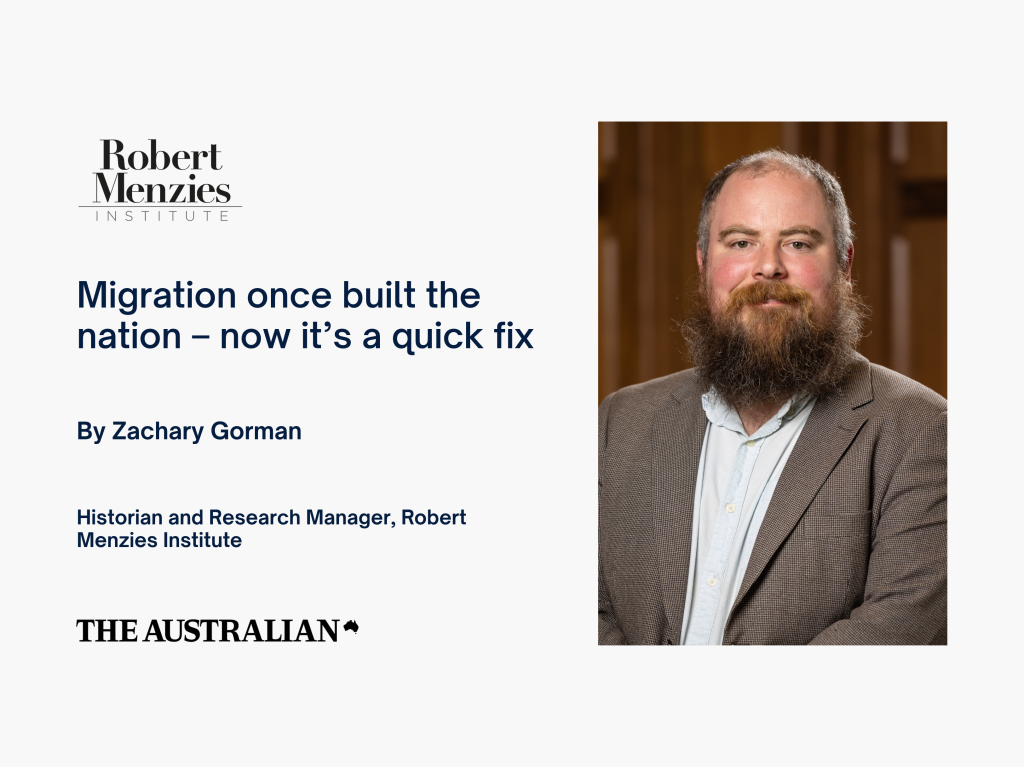
Zachary Gorman is the Historian and Research Manager at the Robert Menzies Institute. This article was published in The Australian on 31 October 2026.
Until recently, modern Australian governments have spoken about immigration settings almost exclusively in economic terms. However, history shows that Australia’s most successful period of large-scale immigration was never originally justified on economic grounds.
Ben Chifley and Robert Menzies risked a populist backlash in broadening Australia’s immigration intake at the height of the popularity of White Australia to embark on a visionary project of nation-building.
They tied immigration to an optimistic story of post-war national progress in which migrants would be readily brought into a community that had a clear and positive sense of direction.
In comparison, the policy goal of 21st-century governments of both stripes can be described most charitably as nation-repairing: using immigration in a patchwork attempt to place temporary fixes on stagnant productivity, falling birthrates and chronic skills shortages. It reeks of pessimism and desperation, and as housing and cost-of-living pressures continue to mount it is little wonder that the public is no longer buying in.
It’s true that during the 1950s and 60s record levels of immigration went hand-in-hand with consistent improvements in living standards and rising rates of homeownership. But this is not what anyone expected at the outset.
In a 1943 speech advocating for the new approach, Menzies warned the country not to be “timid about the temporary effect, social and industrial, of large migration”. The assumption was that new arrivals would put downward pressure on wages and upward pressure on a construction industry already playing catch-up from years of war and economic hardship. These were fears that productivity gains and favourable international conditions helped mid-century Australians fortuitously avoid, but their modern counterparts have not been so lucky.
Immigration was not designed to make Australia richer. It was meant to make us stronger, more vigorous and resilient to the frequent shocks that the first half of the century had taught us to expect. Nation-building meant hoping for the good times, preparing for the bad and in both cases building on the sense of collective effort the war had engendered.
Snowy Hydro and the Holden motor car were never the most efficient ways to provide electricity or transport, but they were rather direct ways of increasing an industrial capacity that had been found wanting in the fight against Japan.
In the early Cold War years there was a widespread assumption that World War III was coming. Given that the century’s first global conflict had rapidly begat a second, a third seemed more than likely.
In this context it’s understandable that we were highly demanding that migrants become part of one Australian community. We needed unity to face whatever challenges lay ahead.
But we quickly learned that the demands of strict assimilation were counter-productive and had made a rhetorical shift towards “integration” by the close of the 50s. In speeches Menzies often emphasised how he cherished his Scottish roots, and migrants were welcome to likewise celebrate their own heritage. The one caveat was that it must never come at the expense of committing their primary loyalty to their new home.
Moreover, for all the manifest failings of assimilation, we made a concerted effort in reaching out to “new Australians”.
The concept of Australian citizenship (as opposed to British subjecthood) was a Chifley era invention, coming into effect on Australia Day 1949.
Every year that followed there would be elaborate and expensive citizenship conventions, which immigration minister Harold Holt defended from a parsimonious treasurer as the “best weapon” yet found to combat anti-immigrant sentiment.
More than 300 community groups were enlisted in a Good Neighbour Movement, inviting migrants into clubs and homes, and offering advice about Australian laws, customs and peculiarities.
These days there are virtually no settlement services for non-refugee migrants. The assumption is that they already need English proficiency and background knowledge to pass the points test for a skilled visa in the first place.
But this reveals the core problem. Immigration is no longer viewed in terms of community and constructing a shared future. It is simply a transaction and often quite a temporary one.
Blame rests with the odd political pairing of Gough Whitlam and John Howard. Whitlam actually cut immigration in response to the economic headwinds of the 70s, revealing that the costs of which Menzies warned remained an accepted orthodoxy.
But in importing a multicultural framework designed to deal with Quebecois separatism in Canada, Whitlam and immigration minister Al Grassby overcorrected from White Australia, thereby abandoning any notion that there was a distinctive and unifying national culture.
Howard tried to fight a rearguard action in defence of that culture, famously introducing a citizenship test requiring new migrants to identify Don Bradman. But in trying to justify high immigration to a sceptical conservative constituency goaded on by the first iteration of One Nation, Howard began the trend of exaggerating immigration’s financial windfall.
This windfall is largely captured by incumbent governments that get a short-term sugar hit to their budget outlays while leaving the inevitable infrastructure and social service costs to successors. Even Treasury figures downplaying these costs estimate the lifetime dividend of an average migrant at just $41,000. The economic histories of Ian McLean and Mark Cully have shown that immigration can help fuel a cycle of growth once it is already in motion, as it was in the early 2000s. But they make clear that nothing in Australia’s past suggests that it makes us richer per capita or can, of itself, help rekindle the fires of prosperity from the cinders and ashes we are now left with.
On the other hand, history does clearly suggest that anti-immigrant xenophobia is inflamed by cost-of-living pressures, such as when immigration restrictions were toughened during the Depression, in a manner the post-war program had to correct.
But the greatest source of the anxiety that begets populism is the lack of a positive sense of direction, of the kind Chifley and Menzies’ nation-building program engendered. People were less worried that migrants would reject the Australian way of life when we were more self-confident and bipartisan in boasting that it was the best the world had to offer.
It was this self-assurance, bolstered by having overcome the greatest existential threat the nation had yet faced, that helped generate the conditions under which White Australia was gradually dismantled.
Shielded by mining boom prosperity, we’ve spent decades naval gazing about our own shortcomings, and it has left us ill-equipped to deal with real challenges now that they’ve finally returned. Australia Day has gone from being the essential ritual through which new citizens were welcomed, to epitomising the degree to which we don’t really know what we are welcoming them into.
Australia needs to recapture the sense of pride, community and momentum that is the prerequisite of all real social cohesion, particularly one sufficient to deal with national crises that appear to be rapidly escalating in scale.
That is why the Robert Menzies Institute’s new report, Conditions for a Successful Immigration Policy, makes an urgent plea to resurrect a holistic nation-building approach. It’s imperative that we move on from the extremes of a multiculturalism that denies the existence of a distinctive and healthy national culture, and the soulless fiscal calculus that has resulted in up to 10 per cent of Australia’s population living here temporarily.
The overwhelming majority of migrants should be coming here because they are attracted to our culture and want to become citizens. But until Australians exhibit a greater respect for citizenship, national history and community, migrants are not being given a positive example to follow or a story they can buy into.
You can find Zachary's article in The Australian hereSign up for our monthly newsletter to hear the latest news and receive information about upcoming events.
Sign up for our monthly newsletter to hear the latest news and receive information about upcoming events.