23 Sep, 2026
2026 Annual Oration delivered by Andrew Roberts, Lord Roberts of Belgravia
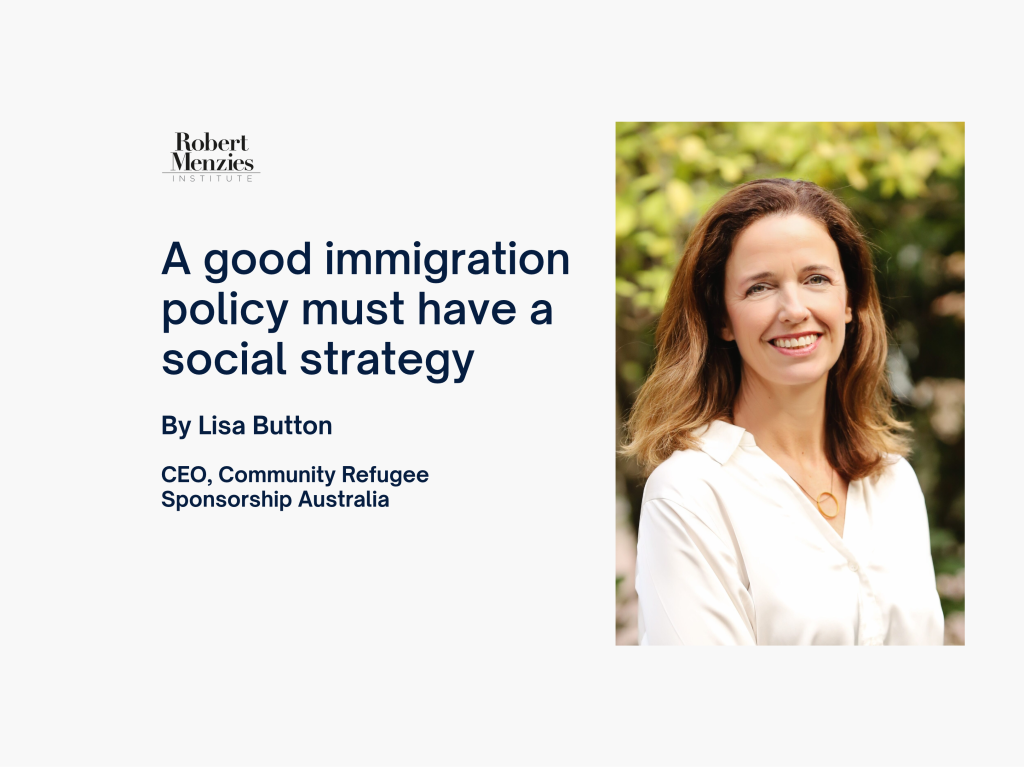
Lisa Button is the CEO of Community Refugee Sponsorship Australia, and is a contributor to a new Policy Paper by the Robert Menzies Institute, Conditions for a Successful Immigration Policy, published by the Robert Menzies Institute. The article below is based on her contribution.
***
Recent events in Australia have created an urgency around the issue of immigration: how can Australia continue to embrace migrant newcomers while also remaining a cohesive, unified country?
My long-standing experience in refugee settlement to Australia offers the following answer: We must add a social strategy, aimed at building robust connections between old and new Australians, to our immigration policy that sits alongside its population, economic, housing, infrastructure and foreign policy settings.
In fact, one of our most significant periods of migrant settlement explicitly inserted such a strategy into its immigration policy by way of the Menzies-era Good Neighbour Movement.
Few would dispute that migration has been foundational to modern Australia’s prosperity, personality and global relevance. Migration (including humanitarian migration) has built our population and workforce, supported economic growth and regional development, and strengthened innovation through new skills, enterprise and global connections.
We may be an island, but Australia cannot stand apart from a complex world marked by globalised trade, economic interdependence, wealth inequality and incredible levels of human displacement. For a large and wealthy country, a strong and well-managed immigration program is both a practical necessity and a global responsibility.
Socially, economically, environmentally, culturally and morally – immigration is a fact of modern Australia. We can debate the exact numbers and composition, but one way or another, it is here to stay so we should focus on making it work!
Which leads me to the topic of social cohesion and the social licence required for ongoing immigration.
Through my work in promoting ‘community sponsorship’ of refugees over the last 8 years, I’ve noted a dearth of large-scale initiatives that encourage everyday Australians to get to know newcomers in ways that break through the silos of culture, language and religion. We have world-class settlement services but the gap I’m flagging is not a case management gap, it’s about social connectivity. Many Australians are simply not engaging with ‘stranger newcomers’ (ie those with whom they have no pre-existing social links) other than in incidental or transactional ways.
I can’t tell you how many times I’ve met newcomers, often people who have been in Australia for many years, who tell me they’ve never been in the home of ‘an Australian’ (however they may define that term).
Once our schools offered organic interactions between migrants and established Australians, but with private schooling on the rise and both parents typically working, that window for social interaction has considerably narrowed.
Modern workplaces are generally structured, output driven and can’t be relied upon to prioritise or encourage the kind of social experiences that once bonded colleagues, and brought them and their families together on a personal level.
Some places of worship embrace a wide range of different ethnicities, but do not typically engage with people who have different religious beliefs.
Australians, new and old, need to be encouraged to be curious and meet one another in ways that highlight that we have far more in common than we have differences – the foundation of intercultural trust.
The Good Neighbour Movement of the post WWII era was an attempt to create the social connective tissue that I’m referring to. Launched nationally in 1950 after earlier instigation in South Australia, a Commonwealth-supported network of state Good Neighbour Councils mobilised churches, welfare bodies, community organisations and thousands of volunteers to help newly arrived migrants settle and to build public acceptance of postwar immigration.
It was a creature of its time, operating during the ‘White Australia’ era and often critiqued as being assimilationist rather than multicultural in its agenda. I also suspect it was also heavily reliant on the usual members of the unpaid care economy – women and retired people. However, while we might critique it through a contemporary lens, the instinct behind it was well-founded.
More recently, national programs like the Community Refugee Settlement and Integration Program (CRISP) show what can happen when everyday Australians are invited to take an active role in welcoming and supporting the integration of refugee newcomers. Aside from boosting economic participation and other settlement outcomes, the value of the social capital created is priceless.
An ABC Australian Story episode recently featured a group of Jewish Australians who welcomed Naima, a Somali Muslim woman, and her 21-year-old son Feisal through the CRISP, leading to a deep and abiding ‘family like’ relationship that transcends differences in religion and culture. In Feisal’s words, the question that really matters when people meet face-to-face is ‘Are you a good person, and can we get along’.
Whatever the numbers, whatever the composition, an investment in a culture of ‘welcoming’ and fostering strong intercultural social connections is needed to ensure that we truly capitalise on the nation building benefits of immigration.
Such an investment would also support strong social cohesion and inoculate our leaders and citizens from the temptation to scapegoat migrants in times of social or economic stress.
Read the paper: Conditions for a Successful Immigration PolicySign up for our monthly newsletter to hear the latest news and receive information about upcoming events.
Sign up for our monthly newsletter to hear the latest news and receive information about upcoming events.