Outline
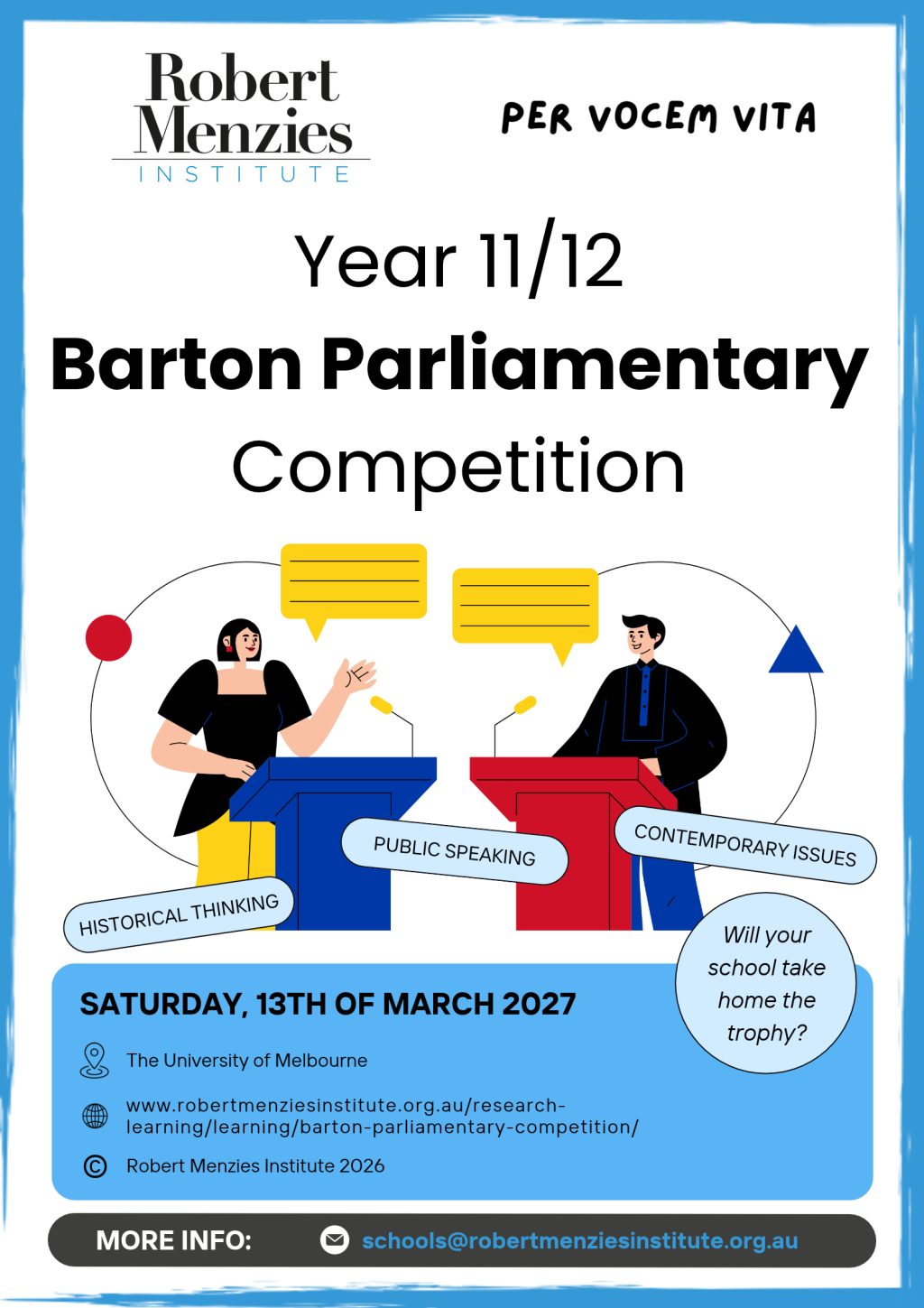
The Barton Parliamentary Competition is a collaboration between Per Vocem Vita and the Robert Menzies Institute designed to stimulate thinking and debate on lively political topics. We empower students in discussions of both historical and contemporary issues.
The competition is named in honour of Australia’s first Prime Minister, Edmund Barton, whose government passed significant early legislation including the Immigration Restriction Act 1901, the Defence Act 1903 and the Judiciary Act 1903.
During the competition, students will debate three bills in mock-parliamentary proceedings. The first bill will be on a contemporary issue, related to current debates occurring in the media. The second bill will be on a historical issue, drawn from the time of Australia’s longest serving Prime Minister, Sir Robert Menzies. The last bill will be on a secret contemporary issue, for which no prior research or preparation will be conducted.
2027 Issues
Issue 1 (contemporary) will be: “Murray Darling Basin and Water Buybacks”
Issue 2 (historical) will be: “National Security Act 1939”
Issue 3 (contemporary) will remain secret until the 13th of March 2027!
Key Information
Schools are encouraged to register their participation via the form below, under the ‘Registration’ tab. If you are a student who wishes to participate, please share this webpage with a teacher at your school who may be able to facilitate your participation.
This competition directly rewards historical research, investment of time, and strong oratory skills. Students who work on developing these three areas are highly likely to succeed.
Schedules and further details will be provided to schools upon registration to the competition.
Judging
- Competitors will be scored on the following categories.
- Oratory prowess; the vocal style (volume, tonal intonation, pace and fluency) and body language (eye contact, gestures and stance) used in the speeches and questions delivered by the competitor
- Substantive contributions; the quality, accuracy, responsiveness, uniqueness and significance of amendments, speeches and questions delivered by the competitor
- Historical accuracy and relevance; how well researched and faithful to their assigned position the competitor is throughout the debate
- Teamwork; how equitably and strategically the team divides their labour
- Judges have the discretionary ability to act on reports of misconduct by deducting points from teams, based on the circumstances of the transgression
- Each competitor’s individual performance will be evaluated alongside their teammates’ to award each team a final score at the end of each debate
- Teams will be ranked in order of their combined score at the end of the three debates, so that the team with the highest combined score is awarded the trophy
Note: the preceding is excerpted from Standing Order 5 of the Barton Parliamentary Competition Standing Orders, accessible in the Barton Parliamentary Competition Handbook.
Prizes
The winning team will be awarded the Barton Parliamentary Competition trophy at the conclusion of the day’s proceedings.
The individual awarded Best Parliamentarian will be given a set of four books, published by the Robert Menzies Institute, as well as a student membership of the Institute.
All students will receive a certificate of participation on the day.
Handbook
Students are advised to familiarise themselves with the Barton Parliamentary Competition Handbook prior to the competition and to inform their research and preparation.
Advice from the 2026 Best Parliamentarian: Patrick Rule
How did you find the challenge of preparing for the Secret debate topic on the day?
The thing I found most challenging when preparing for the secret topic was analysing the different stakeholders and perspectives in the pieces of media provided, as some news articles predominantly showed one side of the issue, making it difficult to find compromises that could possibly satisfy more stakeholders.
What was the most enjoyable part of the Competition?
The most enjoyable part for me was the ability for me to practice my public speaking skills with my around historical topics which are not usually covered by debating competitions.
What did you learn from the experience?
The most interesting thing I learned when preparing was the different jurisprudence surrounding Communist Party of Australia vs Commonwealth, Specifically that fact the Communist Party of Australia had previously been banned during WW2 under the pretence of national security. It was fascinating to hear the Justices of the High Court’s opinions as to whether or not the same justifications apply in peacetime.
Do you have any advice for students planning to enter the Competition in the future?
For future students, dive deep into both primary and secondary historical sources and understand the different perspectives at play. This will allow you to understand what rebuttals will be made as well as how you can best respond to them and what issues or parts of the bill you can trade off in order to achieve what you truly care about.
Sign up to our newsletter
Sign up for our monthly newsletter to hear the latest news and receive information about upcoming events.