
27 Oct, 2026
Lisa Button: A Good Immigration Policy Must Have A Social Strategy
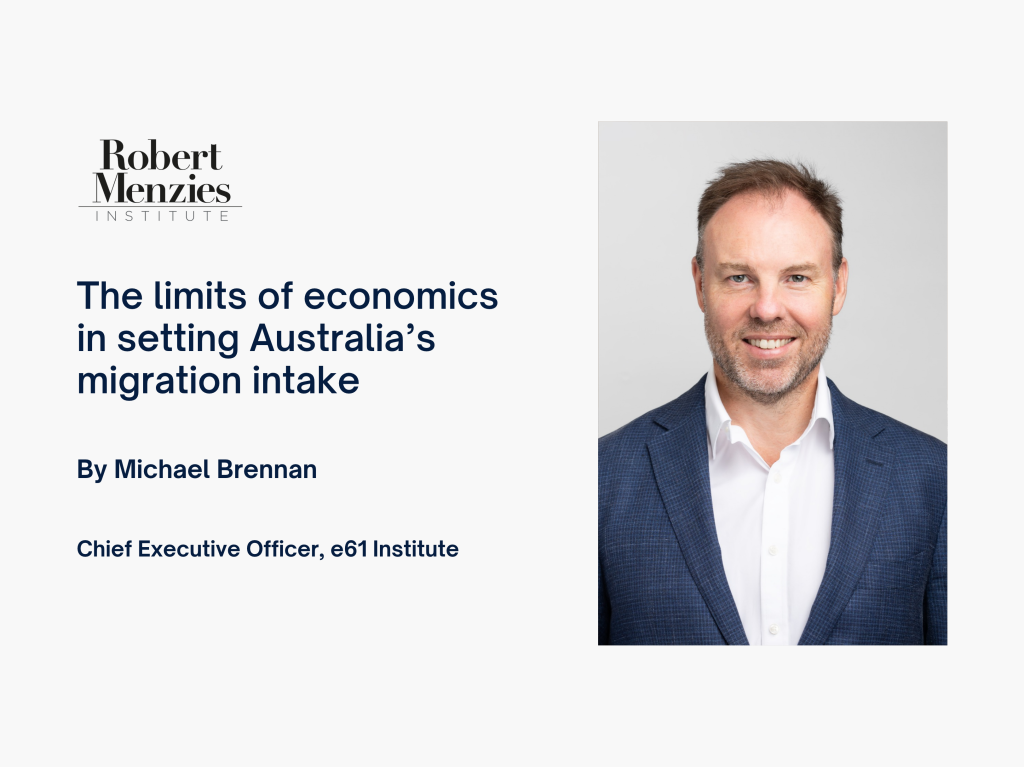
Michael Brennan is the CEO of e61 Institute and is a contributor to a new Policy Paper by the Robert Menzies Institute, Conditions for a Successful Immigration Policy, published by the Robert Menzies Institute on 27 October 2026. The article below is based on his contribution.
It has become an entrenched economic orthodoxy in Australia to say that immigration drives economic growth and prosperity.
Like most orthodoxies, it is worth a good hard look.
Detailed analysis of the lifetime costs and benefits of migration has shown that in aggregate, the net gains or losses are too finely balanced to give any meaningful direction to the key question that plagues our national conversation – how many immigrants should be allowed into the country?
Immigration brings substantial benefits, but it also creates costs. Migrants can gain enormously through higher lifetime earnings and the opportunity to build a new life in Australia. Universities and employers also benefit. But the pressures on housing, transport and other infrastructure are borne by the wider community.
The benefits and costs do not necessarily fall on the same people, which is why we need a longer and wider lens to understand the economic contribution of immigration to Australia.
In recent years, Treasury has more rigorously estimated the lifetime fiscal impact of an additional permanent migrant. The headline figures are interesting, but what is more revealing and useful is the detail that sits beneath the estimates.
Its initial estimates suggested that the average migrant would provide a net fiscal benefit of a modest $41,000 (in today’s dollars).
But the results varied substantially by visa type. Skilled migrants were estimated to provide a net benefit of close to $200,000, while family reunion migrants were associated with a net cost of $126,000 and humanitarian migrants a net cost of $400,000.
Within the skilled stream, the net benefit is higher for the primary visa holder (over $500,000) than for the secondary visa holder (closer to $50,000).
Complicating the matter is that these figures depend on assumptions about the future – the method used to translate future costs and benefits into today’s dollars.
Another factor affecting this analysis is age.
The Treasury analysis found the biggest single driver of the net fiscal benefit of a skilled migrant was their age (specifically, their relative youth).
The difference between the contributions of an average skilled migrant and that of the average Australian is $285000. However, nearly 60% of this difference is driven by the different age profile of migrants relative to the domestic population.
It is an open question whether more of the difference should come from Australia’s ability to pick particularly highly performing workers, not just younger ones.
In other words, should we be doing better in terms of the migrants we select?
What’s more, could we be doing better in supporting migrants to achieve their full potential once here?
Recent work by the e61 Institute has focused on how migrant labour is distributed across the economy by examining the firms in which recent migrants work.
We found that migrants are, on average, more likely to work in low productivity industries like hospitality or in administration and support. Naturally this is truer of student visa holders and working holiday makers than it is of permanent skilled migrants.
These findings suggest that some migrants may not be working in jobs or businesses where their skills can be put to the best use. Complex visa rules may contribute to the problem.
Nor can we definitively say that migration is supporting regional development.
First, because the definition of ‘regional’ is broader than most ordinary Australians would expect: it includes Perth, Adelaide and Canberra. And second because migrants working in the region tend to earn less than others in metropolitan areas.
On average, once their visa conditions expired, e61 research shows that they were able to earn (on average) $5,000 more by moving location. So forcing them to work in the regions could be suppressing their economic output for the nation.
The upshot is that economics offers marginal guidance on the optimal size of the permanent migration intake.
However, where it might have more to say is the composition of the intake, and the rules governing different streams within the overall program.
There are big gains from migration, but the gains flow to particular parties – who have an incentive to lobby for more immigration.
This combination of competing interests and centralised government controls, such as rigid skills lists, is a magnet for rent-seeking and risks producing a system that serves neither migrants nor Australia as well as it could.
Rather than expecting economics to offer one answer on how many migrants should be allowed into our country, we should use it to identify under what conditions does immigration work, where is it falling short, and how can we make migration work better for everyone.
Read the Paper: Conditions for a Successful Immigration PolicySign up for our monthly newsletter to hear the latest news and receive information about upcoming events.

Sign up for our monthly newsletter to hear the latest news and receive information about upcoming events.