7 Sep, 2026
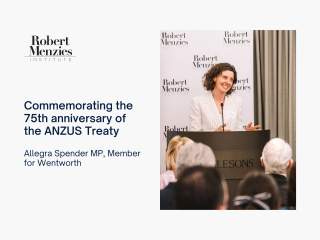
Allegra Spender MP Commemorates the 75th anniversary of the ANZUS Treaty
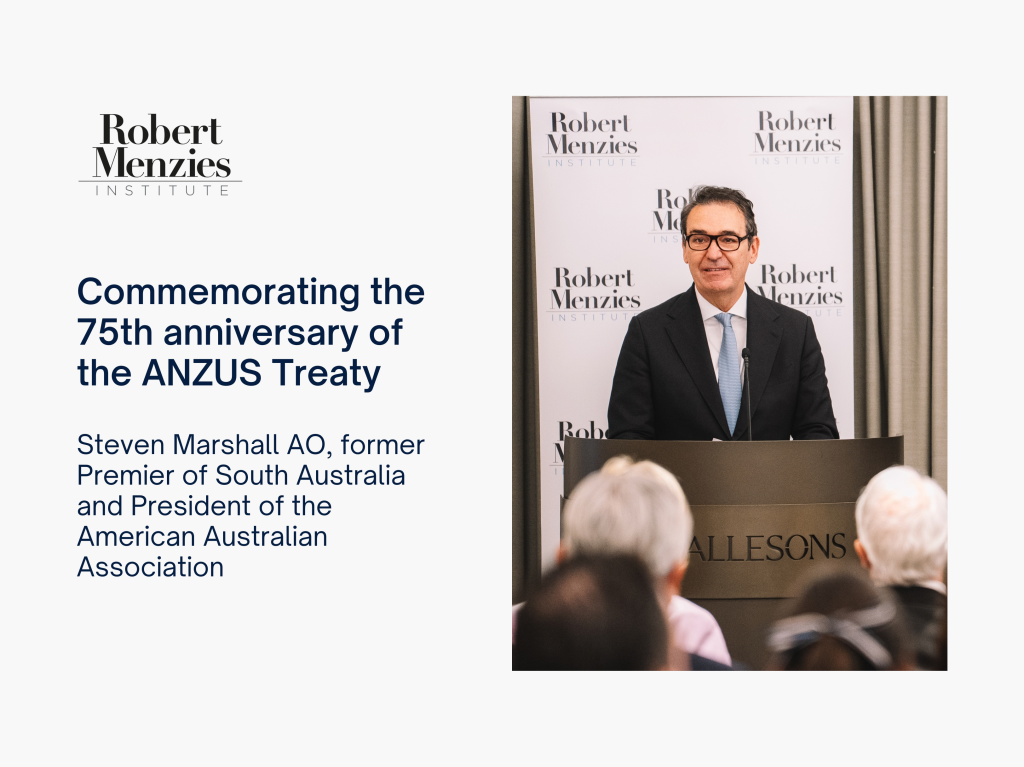
Steven Marshall AO delivered this speech in Sydney at our event commemorating the 75th anniversary of the signing of the ANZUS Treaty, which also launched the Institute’s new historical fiction The Hidden War.
It is a great pleasure to be here with the Robert Menzies Institute for the launch of The Hidden War.
And there could hardly be a more appropriate day to do it. Because exactly 75 years ago today — on 1 September 1951 — Australia, New Zealand and the United States signed the ANZUS Treaty in San Francisco.
Today we tend to look back at ANZUS as one of the permanent features of Australian foreign policy. It has existed for our entire lives — certainly for the lives of every student in this room. And because we know what happened afterwards, there is a temptation to think that ANZUS was somehow inevitable.
But it wasn’t.
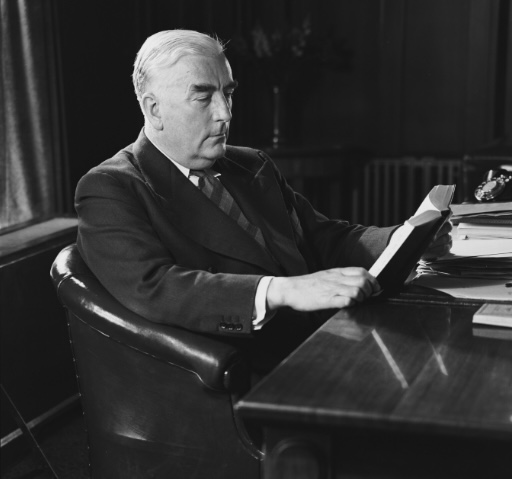
In 1951, Robert Menzies was Prime Minister of Australia. It was only six years since the end of the Second World War. The Korean War was underway. The Cold War was taking shape. Australia still had enormously strong political, cultural and emotional ties to Britain.
And yet the Menzies Government recognised that the strategic world around Australia had fundamentally changed.
Australia needed to build a much deeper and more enduring relationship with the United States. Percy Spender was absolutely central to making that happen.
Allegra is much better placed than I am to speak about her grandfather, and I don’t intend to retrace that history tonight. But there is one aspect of his story which I think is particularly relevant to the young people in the room.
Spender understood that Australia could not simply wait for the world to arrange itself in our favour.
Australia had to have an idea of the world it wanted — and then work to create it. There was nothing automatic about the United States agreeing to the treaty Australia wanted. It required determination, persuasion and diplomacy. And I think that is worth remembering.
Because when we study history, particularly at school, there can sometimes be a sense that history is simply a sequence of things that happened: A war began. A government was elected. A treaty was signed. An institution was created.
But history doesn’t happen by itself: People make choices. People have ideas. They persuade others. They take risks. And sometimes those decisions have consequences that last far beyond their own lifetimes.
Seventy-five years ago today, Percy Spender put his name on a relatively short document in San Francisco. I wonder whether even he could have imagined that three-quarters of a century later we would still be gathering to talk about it. And I wonder what Robert Menzies and Percy Spender would make of the Australia–United States relationship today.
I think there would be much that they would recognise: They would certainly recognise the fundamental importance of the United States to Australia’s security. They would recognise the importance of a stable and peaceful Indo-Pacific. And they would understand that Australia, as a country with an enormous continent and a comparatively small population, benefits enormously from having strong and reliable friends.
But I think they would also be astonished by how broad the relationship has become.
Today our partnership is about defence and intelligence, certainly: But it is also about technology. Artificial intelligence. Quantum computing. Space. Critical minerals and energy. Medical research. Universities. Investment. Culture. Film and music. And increasingly sport, as we look towards the Los Angeles Olympics in 2028 and Brisbane in 2032.
And, of course, it is about people. I see this every day in my current role as President of the American Australian Association. Thousands of Australians and Americans study, work, conduct research, build businesses and create things together. We provide scholarships to extraordinary young Australians to study and conduct research in the United States, and to Americans coming in the other direction.
And one of the things I’ve learned is that alliances ultimately aren’t sustained by pieces of paper. They are sustained by people. Governments can sign treaties. But relationships between countries become enduring when people know one another, trust one another and do things together.
And that brings me to the students here tonight.
I was particularly pleased to hear that so many participants in the Menzies Speech Competition would be here. Because there is another anniversary worth thinking about.
Tonight we are celebrating the 75th anniversary of ANZUS. But in just 25 years’ time, in 2051, Australia and the United States will mark its centenary.
And when ANZUS turns 100, it won’t be my generation deciding what this relationship looks like: It will be yours.
Some of you in this room may be running Australian companies. Some may be scientists or researchers. Some may serve in our Defence Force. Some may become diplomats. Some may work in technology or the arts. And perhaps one or two of you will find yourselves sitting in the Australian Parliament.
The world you inherit will be very different from the world of Menzies and Spender.
Artificial intelligence alone is going to transform our economies and our societies in ways that we are only beginning to understand. The strategic balance in our region is changing. The challenges facing democracies are changing. And undoubtedly there will be issues confronting Australia in 2051 which none of us in this room tonight can possibly predict.
So, your generation shouldn’t simply ask: “How do we preserve the alliance?”
I think the more interesting question is: “What do we do with it?”
How can Australia use this extraordinary relationship to make our country safer and more prosperous? How can we use it to accelerate scientific discovery? How can we build new industries? How can we strengthen our democratic institutions? And how can Australia contribute more to the partnership ourselves?
Because there is another important lesson in the story of Percy Spender. Australia wasn’t simply a passenger in the creation of ANZUS: Australia had an objective. Australia argued for it. Australia exercised influence. And Australia helped shape the outcome.
That is an important lesson for Australian foreign policy today. Being a good ally doesn’t mean surrendering your independence. A strong alliance should give Australia greater capacity to exercise it. We should have confidence in the contribution that Australia makes. And we should have confidence in our ability to shape the world around us.
Perhaps that is why The Hidden War and projects like the Menzies Speech Competition are so important.
History isn’t simply about knowing what happened. It helps us understand that the institutions we inherit were once merely ideas: Someone had to imagine them. Someone had to argue for them. And someone had to build them.
Seventy-five years ago today, Robert Menzies was Prime Minister and Percy Spender was Australia’s Ambassador in Washington. They belonged to a generation of Australians who had lived through depression and world war and were confronting a profoundly uncertain international environment. They looked at the world Australia had inherited and decided that Australia should help shape what came next.
Tonight there is another generation of Australians in this room. And by the time ANZUS turns 100, it will be your turn.
The question won’t simply be whether the treaty survived. The much more important question will be: What did your generation make of it?
I look forward very much to finding out. And I particularly look forward to meeting the Speech Competition participants after the formalities tonight.
Congratulations to all of you, congratulations to the Robert Menzies Institute, and congratulations to Belinda on The Hidden War.
Thank you to Steven for this wonderful speech from our event.
Sign up for our monthly newsletter to hear the latest news and receive information about upcoming events.
Sign up for our monthly newsletter to hear the latest news and receive information about upcoming events.