
25 Aug, 2026
2026 Menzies Speech Competition Winners
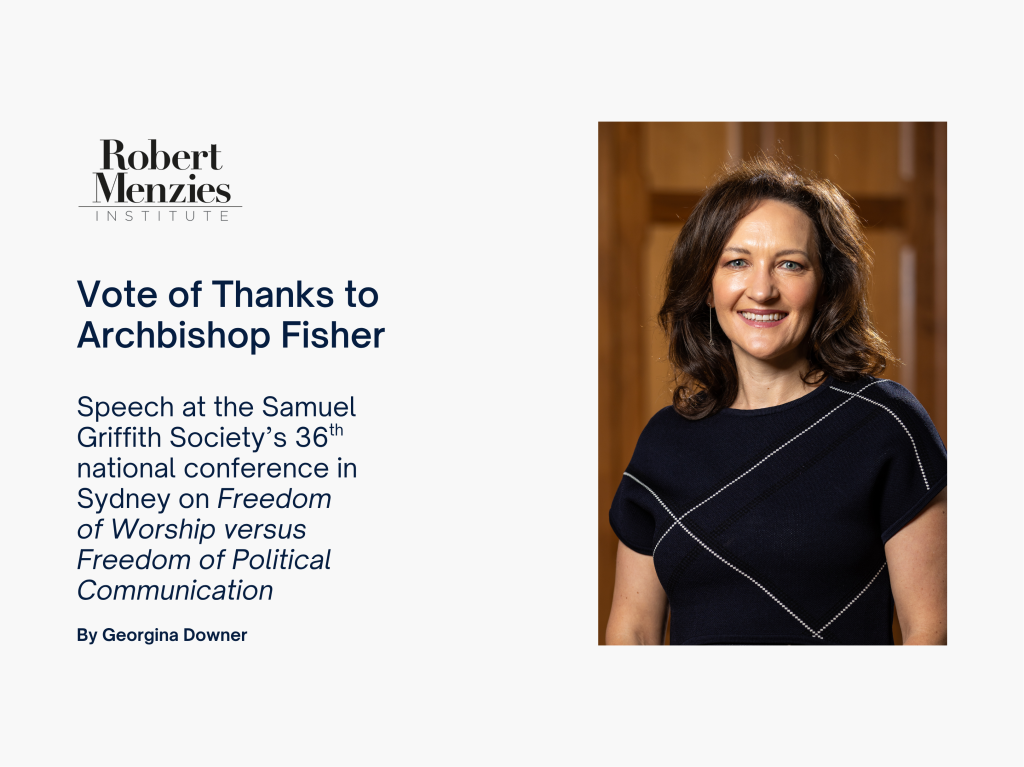
A couple weeks ago, the Institute’s Chief Executive, Georgina Downer, visited Sydney for the Samuel Griffith Society’s 36th annual conference. Running from Friday 21 August to Sunday 23 August, Georgina was honoured to offer the vote of thanks to Archbishop Anthony Fisher for his compelling address: Freedom of Worship versus Freedom of Political Communication: ne’er the twain shall meet?
Enjoy the full speech by Georgina below:
One of the central points made by Archbishop Fisher tonight is that while
we have rights — implied or explicit — we also have responsibilities. And
too often in our modern public discourse we emphasise the former while
neglecting the latter.
Without wishing to sound too nostalgic for days of yore, this was a language
Robert Menzies understood very well. Throughout his Forgotten People
broadcasts, including those in which he reflected on Roosevelt’s Four
Freedoms, Menzies returned repeatedly to the relationship between
freedom, personal responsibility, individual dignity and duty to the
community.
That language seems sadly absent from much of today’s public debate.
The eruption of the politics of rage around issues such as Gaza, climate,
race and gender has contributed to a worrying polarisation and rupture
across much of the West.
And Archbishop Fisher’s description tonight of the cumulative effect of
perpetual protest resonated particularly strongly with me.
The Robert Menzies Institute, which I have had the privilege of running for
the past five years, is located in the Old Quadrangle at the University of
Melbourne. Immediately adjacent to our oƯices and museum is South
Lawn, which was home to the pro-Palestinian encampment during much of
the first half of 2024.
Students, academics and visitors had classes disrupted and, in some
instances, were subjected to intimidation and threats. The protests began
to interfere with the core business of the university — teaching and
learning.
So while Archbishop Fisher has spoken tonight of the tension between
freedom of political communication and freedom of worship, at Melbourne
we confronted a related tension: between freedom of political
communication and freedom of education.
And the question is essentially the same. At what point does the exercise of
one freedom begin improperly to diminish the freedom of somebody else?
What has so often been missing from those who shout loudest in defence
of their own protest rights is precisely the responsibility Archbishop Fisher
has spoken of tonight: responsibility to others, and responsibility to the
common good.
There is also a particular personal resonance for me in hearing these
questions discussed at the Samuel Griffith Society.
My great-grandfather, Sir John Downer, was one of the federationists who
helped frame our Constitution. At the 1897 Convention he served with
Edmund Barton and Richard O’Connor on the three-man drafting
committee that gave legal form to the Constitution.
So I cannot resist wondering what he might have made of tonight’s
discussion.
The Constitution he helped draft contains an express provision concerning
religion in section 116, while the freedom of political communication we
have been discussing tonight was subsequently implied by certain
members of the High Court from our system of representative government.
Of course, section 116 is itself limited — principally restraining
Commonwealth legislative power — so I would not suggest that this settles
the hierarchy of freedoms. But there is nevertheless a certain irony in our
contemporary debate when an implied freedom of political communication
can sometimes appear to assume greater prominence than freedoms
connected with religion and worship.
Indeed, perhaps both Archbishop Fisher and my great-grandfather would
recognise the deeper point: constitutional government cannot work simply
as a contest in which every citizen insists upon the maximum possible
extent of his or her own rights. It requires restraint, accommodation and an
understanding of the interests of others.
That brings us back to Menzies.
In his broadcast on The Government and Ourselves, he put the matter
memorably:
“a good democrat is one with a silent acceptance of his duty while a bad
democrat is one with a noisy insistence upon his rights.”
There could hardly be a more apposite observation for our present age.
Menzies also understood that freedom of speech was not valuable simply
because everybody should be free to shout more loudly. Its purpose was
the pursuit of truth.
As he argued, because none of us possesses a monopoly on truth, “the
process of free debate — the untrammelled clash of opinion — must go
on.”
That distinction matters.
Free speech and political communication are means by which we pursue
truth in a democratic society. When political action instead seeks to
intimidate, silence, obstruct or prevent others from participating in that
process, we risk mistaking the means for the end.
And perhaps that is one of the most important challenges Archbishop
Fisher has left us with tonight.
How do we protect vigorous political disagreement — which is
indispensable to a free society — while recovering the habits of restraint,
responsibility and mutual obligation without which that freedom cannot
endure?
Political, religious, cultural and institutional leaders have a particular
responsibility to model that civic discourse.
And, especially at this moment, we should be wary of the importation of
ancient and foreign hatreds that damage our social fabric and undermine
the national cohesion on which liberal democracy ultimately depends.
Archbishop, thank you for a thoughtful, provocative and extremely timely
address — and for reminding us that a free society depends not simply upon the rights we claim for ourselves, but upon the duties we recognise
towards each other.
Please join me in thanking Archbishop Anthony Fisher.
Thank you to the Samuel Griffith Society for inviting Georgina to present the vote of thanks.
Sign up for our monthly newsletter to hear the latest news and receive information about upcoming events.
Sign up for our monthly newsletter to hear the latest news and receive information about upcoming events.