7 Sep, 2026
Belinda Murrell Launches 'The Hidden War'
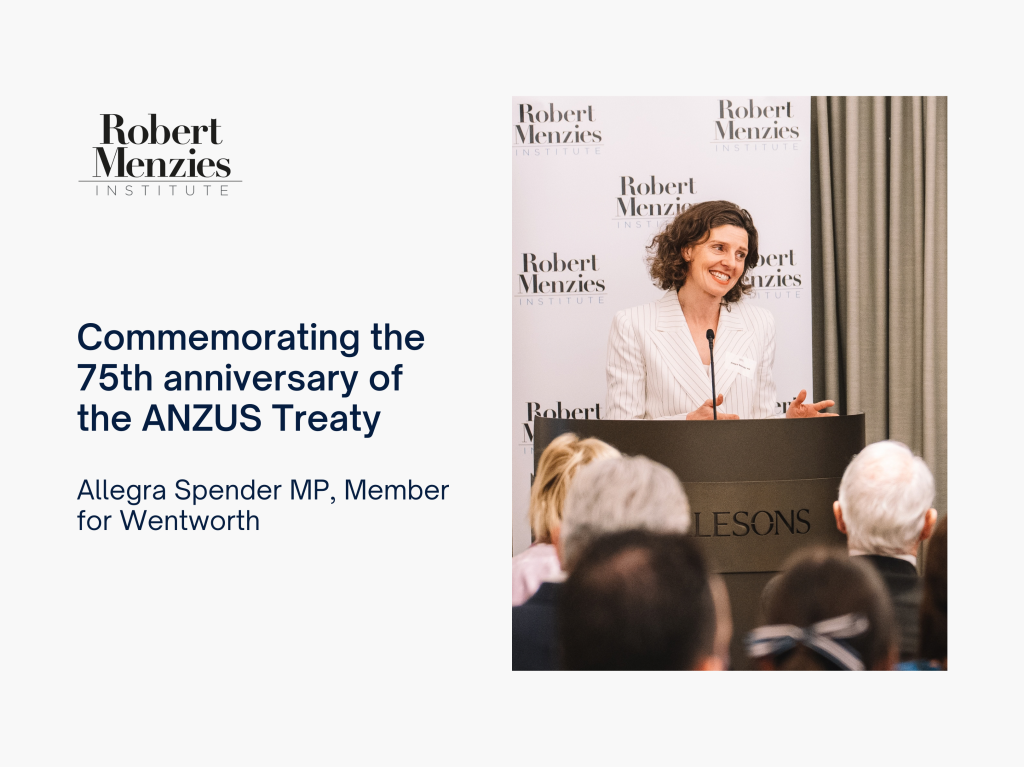
Allegra Spender MP delivered this speech in Sydney at our event commemorating the 75th anniversary of the signing of the ANZUS Treaty, which also launched the Institute’s new historical fiction The Hidden War.
Thank you for having me here tonight. I’m honoured to be invited to speak at the launch of The Hidden War, and in honour of the 75th anniversary of the ANZUS treaty.
I’m here tonight, not only as the Federal Member for Wentworth – with a strong interest in Australia’s role in the U.S. alliance – but also as the granddaughter of Percy Spender, one of the key architects of ANZUS.
And I will reflect on the spirit that moved my grandfather – he recognised that the world was changing, and that Australia needed to change with it. He recognised that after the Second World War, Australia needed to pivot towards America and Asia, and pursued this through the ANZUS treaty and the Colombo Plan. And I think his spirit – that we as a country need to anticipate changes to the world and continually adapt to them – and be honest that our relations with other countries need to be based on mutual national interest, not sentimental cultural ties.
But before I do, I would like to particularly commend the author of The Hidden War, Belinda Morrell, for her fantastic book, that brings the challenges of the times, and illustrates how treaties and significant public policies are actually developed. Congratulations on this wonderful contribution.
Like the rest of Australia, I’ve been thinking a lot about the state of this alliance: with AUKUS, with Trump, and with this 75th anniversary all converging at once. Tonight, I want to reflect on where I think we are, and what our future looks like.
When we talk about the state of the alliance and its ongoing relevance, we must look back before we look forward.
The ANZUS treaty was not something the US handed over readily. It was extracted, piece by piece, from a country that ultimately saw us a low priority – a small ally with limited strategic assets to offer in return.
A few things are worth remembering about how it came together:
In actual fact, many agree the main reason it was agreed to by the US – was to reassure an anxious Australia and New Zealand after the US entered into a security agreement with Japan.
At the centre of that negotiation was my grandfather. He saw, earlier than most, that Australia’s future security had to lie with the Pacific, anchored by a strong US defence relationship. This came at a time when the U.S. was emerging from isolationism after WWII, and Britain’s global power was in decline.
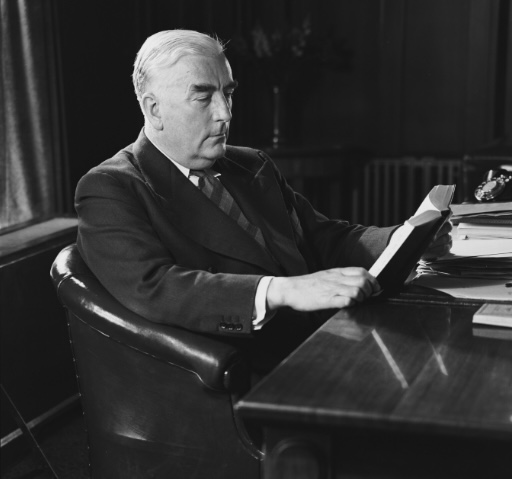
He was pretty strategic about how he pursued it. While Menzies, who was reluctant to decouple so explicitly from Britain, was overseas – Percy committed Australia to sending troops to the Korean War in advance of Britain’s own announcement. It was a deliberate signal: for the first time, Australia was writing its own Pacific policy, instead of blindly following London.
He didn’t get everything he wanted. He’d hoped for a NATO-style guarantee with real access to US strategic decision making. What Australia got was more modest: a treaty built on consultation, not a guarantee of automatic mutual defence.
Today, the U.S. alliance is still our key security partnership. And it is still important, both strategically and in the eyes of the public.
Strategically, the most consequential part of the relationship is arguably the least visible: intelligence-sharing, interoperability and technology access. This show up in a few ways:
Much of this could not be plausibly replicated by Australia alone – which is why many see the alliance as preferable to standing outside the US strategic system altogether.
That view is shared broadly by the public. Lowy Institute polling from last year shows that 80% of Australian still rate the alliance as ‘very’ or ‘fairly’ important for security.
Of course – treaties are only as good as the trust that backs them. The Aus/US relationship is far larger than just the looming influence of any one president – but we cannot deny the Trump administration has had an impact.
The world has changed, and power has shifted. We must face this reality.
In 1951, when ANZUS was signed, China was an economically shattered, war-torn country accounting for roughly one-twentieth of world output. The alliance was built to contain a communist bloc that was, by any economic measure, poor and underdeveloped.
To put a number on it: in 1951, China’s share of world GDP was around 5%, on a purchasing power parity basis — a steep decline from roughly a third at its pre-industrial peak in the early 1800s.
Today, that figure is closer to a fifth of the world’s GDP — around 19%, again on a PPP basis — putting China roughly on par with the US as the largest economy in the world by that measure. Asia as a whole now produces somewhere between two-fifths and half of global output, depending on how it’s measured.
And closer to home, China and Japan together now buy almost 38% of everything Australia exports.
We must face the fact that the global order is changing and accept that our alliances need to change with it. This acceptance helps to build the mature Australia we all want to see.
Coupled with the rise of Asia and the importance of the Pacific – as China intervenes in Pacific more – Australia is hedging. We’ve doubled down on alliance management through AUKUS, but we’ve also diversified — with a new defence treaty with Papua New Guinea, and a defence cooperation pact with Indonesia.
The alliance still matters. But we have to be honest – It has changed.
And this cuts both ways. The US has made clear it also wants a more self-reliant Australia. Senior US security and defence officials, including Defence Secretary Pete Hegseth, have repeatedly called on Australia, along with on their other allies, to increase defence spending and do more for our own security.
Pentagon policy chief Elbridge Colby put it plainly: “for the first time since the Reagan era, allied and partner burden-sharing is no longer an afterthought or a ‘nice to have’… it is a core element of our nation’s defence strategy.”
In other words, official US policy now assumes its allies, including Australia, will not simply be able to lean on Washington by default.
Former DFAT Secretary Peter Varghese has argued we should welcome this pressure, not resent it: “The US might yet save us from ourselves”; by making AUKUS terms tough enough to force Australia toward greater self-sufficiency.
And Sam Roggeveen of the Lowy Institute has said Australia needs “a little more self-respect”: “Canberra cannot conjure up a vital US national interest where none exists… Australia can’t want the alliance more than the Americans themselves want it.”
As Hugh White argues, we are facing the biggest shift in our international standing since first European settlement.
It is not only China that has grown: Asia as a whole has grown with it. And we cannot deny that this is where Australia sits. India is now a huge economy in its own right, and within the next 25 years, Indonesia is projected to be the fourth-largest economy in the world.
With this in mind, we can no longer simply rely on America to provide our security in this region. We have a responsibility to our own country to own our own security.
Over the next 50 years, the role of our region, our neighbourhood, will only become more important, and increasingly dictate the terms of security and peace we live under.
The world of 1951, and the world my grandfather foresaw, has changed significantly. But his foresight rang true: our security and our future lie in the Pacific and in Asia. It is now up to us to adjust the balance; of the alliance, and of our relationship within this region and with the United States. It remains an important alliance. But it is not the only one that matters.
It is obvious that a more independent, self-reliant Australia is a stronger and more prosperous one. Genuinely sovereign capability doesn’t just make us a more resilient nation, but it also makes us a better friend and ally to the United States.
Thank you to Allegra for this wonderful speech from our event.
Sign up for our monthly newsletter to hear the latest news and receive information about upcoming events.
Sign up for our monthly newsletter to hear the latest news and receive information about upcoming events.