6 Jul, 2026
Q&A: Joseph Healy on Adam Smith
This article was first published in the Australian Financial Review, 07 July, 2026, by Alex McDermott
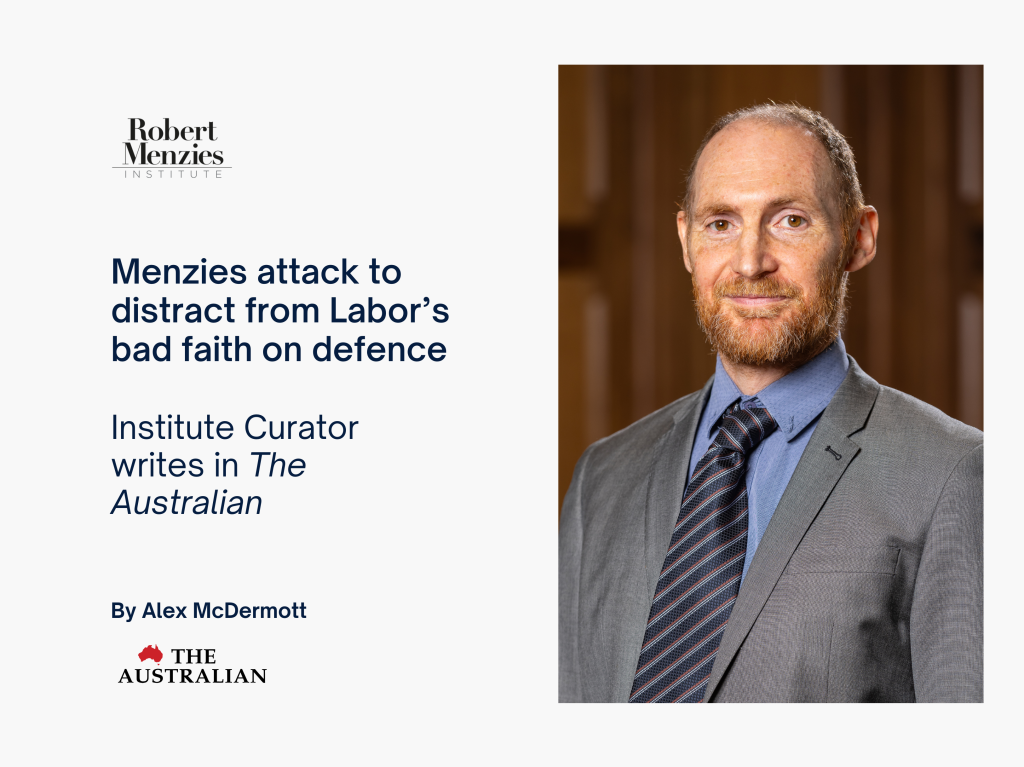
Defence Industries Minister Pat Conroy’s scabrous “Menzies the Nazi appeaser” attack last week was no mere off-the-cuff slip. While the neat timing ahead of the ALP national conference is obvious, the calculation runs deeper than mere factional management. It reveals a government weaponising a distorted version of history to camouflage the glaring mismatch between its defence rhetoric and its strategic reality.
The government’s need to counter the anti-war, anti-America, anti-alliance obsessions that dominate the left is real. Across Labor, the union movement and public commentariat there is a thick river of antimilitarism and reality denial dating back most of its history to freely draw on. Indeed this sensibility has been one of Labor’s defining characteristics.
The occasional exceptions to this rule – Hughes and Fisher leading into World War I, Curtin and Chifley during World War II, and Hawke in the 1980s – make up the minority strand, even as they are among Labor’s greatest achievements. Regardless of the motivation, the narrative Conroy presents is entirely ahistorical. Its falsehoods have been well-canvassed in the days since. Suffice to say that whatever Robert Menzies may have done or said at the time that could in hindsight be criticised as appeasing emergent threats and enemies, Labor, and John Curtin, were far worse.
The meaning of “appeasement” in the 1930s, which practically all sides of our politics, like Britain’s, supported, was avoiding war by removing grievances and grudges through compromise and concession. Joseph Lyons’ United Australia Party government, of which Menzies was a member, pursued appeasement and rearmament simultaneously, seeing both as instruments to secure peace.
Labor was ripe for appeasement but not rearmament. Having destroyed itself as a party of government over conscription in WWI, it embraced pacifism and antimilitarism in the post-war decades, hostile to the British empire, conscription and the military displays of Anzac Day. It urged instead disarmament, pinning hopes on the League of Nations, and welcomed British Labour PM Ramsay MacDonald’s decision to discontinue work on developing the key strategic Singapore naval base.
Labor policy in the 1920s and 30s described war as a by-product of the capitalist struggle for markets and materials. The plan was to establish socialism, country by country, thus abolishing wars. Despite the deteriorating international situation in the critical pre-war decade, Curtin opposed any increases in defence spending – indeed, he complained in 1937 that per capita Australia’s defence spend was higher than any other Dominion country.
Labor’s approach reflected a wider post-war sensibility evident everywhere, a by-product of the horrors of the Great War. For Britain and her Dominion nations especially, it had been a trauma without precedent, the first full-scale continental war the British had directly fought in for centuries. A massive army was dispatched only to be largely destroyed in Europe, cutting a vicious swath through all classes of young men.
In films and literature, across workplaces, church halls and universities, the revulsion against war took on an almost metaphysical dimension. This is why appeasement’s appeal was, however mistaken, practically universal. Those who stood out and argued against it – Churchill in Britain, ex-Labor renegade Billy Hughes in Australia – were indeed voices crying in the wilderness. Today though we lack the excuse of having lived through anything as traumatic as WWI. The past 70 years of Pax Americana have delivered peace dividends beyond any other period’s measure. Yet a reluctance to face strategic realities, alongside a propensity to engage in reality denial – to pretend, for instance, that we are increasing our security and our defence spending when we are clearly not – is just as evident.
The uncomfortable reality Conroy’s ad hominem Menzies attack was designed to distract from is this: AUKUS was not an ALP initiative. It accepted it to avoid criticism for leaving Australia without any credible defence policy in an election campaign. Since coming to power Labor has made bold pledges regarding future defence spending that, going on its track record for solemn pledges, is unlikely to ever materialise.
But while the ALP’s refusal to face strategic reality mirrors its behaviour in the 1930s, the striking feature now is the bad faith. The interwar Labor movement can be accused of many things, but not a failure to be clear about what it really thought.
The issue today is not merely what the government is doing but its consistent insincerity. The pattern of denying the reality of its actions is evident across the board. A tax grab framed as intergenerational equity. A budget apparently meant to increase housing supply when its own published Treasury papers indicate the opposite. Energy policy tailored to placate climate zealots, while blandly assuring voters prices would go down, even as the simple logic of taxpayer-subsidised non-carbon energy meant consumers could not fail to be hit. Not all of this is necessarily lying, but it does show a reckless disregard for the truth.
This pervasive insincerity is why increasingly wide segments of the electorate flock to populist alternatives such as Pauline Hanson with a grassroots enthusiasm no major party can replicate. Hanson presents to her followers as fundamentally sincere or, failing that, demonstrably authentic. It’s extremely hard to cast her as a standard cynical opportunist, despite the best efforts of her opponents.
Voters want constancy, sincerity, and words that function as adequate signposts of actual views and real intentions. Instead, the political establishment looks, sounds, walks and talks like crass opportunists. The 1930s, and the left in Australia especially, had its share of problems, reality denial chief among them. But Conroy’s words, and the PM’s office that tacitly endorses them, demonstrate a stench of systemic corruption in the national conversation.
When set against the actual deeds of the government, Conroy’s talk of “progressive patriotism” is anything but. Its actions reveal it instead to be regressively defeatist: neither patriotic, nor driving progress. Australians deserve better.
Alex McDermott is History Fellow at the Robert Menzies Institute.
Sign up for our monthly newsletter to hear the latest news and receive information about upcoming events.
Sign up for our monthly newsletter to hear the latest news and receive information about upcoming events.