23 Jun, 2026
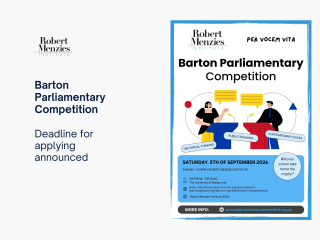
Registrations Open for the 2026 Barton Parliamentary Competition
On Tuesday 28 July, author, banker and entrepreneur Joseph Healy will deliver Robert Menzies Institute’s annual Scottish Enlightenment lecture on ‘What Would Adam Smith Think of Modern Australia’.
The lecture marks the 250th anniversary of the publication of The Wealth of Nations, the book by Scottish philosopher and economist Adam Smith that gave birth to modern economics by explaining how free markets, competition, the division of labour, and secure institutions create prosperity. Joseph Healy is the author of a new book ‘What Would Adam Smith Think of Modern Australia’.
Below we ask Joseph some light rapid-fire questions on the topic.
Buy your tickets to his public lecture HERE.
If Adam Smith walked through Melbourne today, what would delight him—and what would horrify him?
The vibrant nature of a global city, where goods from all around the world are available, then he would learn of our crime rate, and he would ask ‘how can this be so?’
If Adam Smith were Treasurer tomorrow, what’s the first thing he’d do?
Introduce a cap on government expenditure at 25% of GDP, so bringing discipline to expenditure and a focus on things only the government must do.
Which modern debate—housing, immigration, AI, inequality, trade, monopolies, university education—would Smith most want to enter? Why?
Monopolies/oligopolies are endemic across our business landscape, coming at a great cost to consumer choice, prices, innovation, productivity, employment, and career choices etc.
What is the biggest myth about Adam Smith that economists and politicians still repeat?
That the ‘invisible hand’ is evidence of his belief in neoliberalism in extremis. He is still widely, and wrongly, caricatured as the apostle of greed and laisse-faire economics.
You can only recommend one chapter of The Wealth of Nations to someone who has never read Smith. Which chapter is it, and why is it still astonishing nearly 250 years later?
Chapter 2 of Book I, titled “Of the Division of Labour.” This chapter remains central to the key principles in how we understand economics, economic growth, trade, and business strategy.
Smith – Philosopher first, economist second or the other way round?
Smith was the greatest economist ever, but he was first a moral philosopher. He understood that the ‘invisible hand’ of self-interest had to be guided by the ‘impartial spectator’ testing the moral/ethical efficacy of our behaviour.
Who today understands Adam Smith best—and who misunderstands him most?
To understand Smith’s legacy, you must see The Wealth of Nations and his earlier book The Theory of Moral Sentiments as two sides of the same coin. Few people appreciate this. I would say that less than 5% of economists truly understand/appreciate this, so 95% misunderstand him!
What’s the single passage in The Wealth of Nations that almost nobody quotes, but which best captures Smith’s genius?
“No society can surely be flourishing and happy, of which the far greater part of its members are poor and miserable.” (The Wealth of Nations, book I, c viii)
Joseph Healy is a career international banker and mental health entrepreneur. He was a co-founder and CEO of Judo Bank, a bank created to serve the needs of the SME economy – the baker, the butcher, and the brewer. He is also a co-founder and Executive Chairman of Malu Health Group, which specialises in mental health care.
Joseph holds six master’s degrees in subjects covering financial economics, business studies, Chinese studies, and the psychology and neuroscience of mental health. He is the author of What Would Adam Smith Make of Modern Australia? How Lessons from the Past Provide Answers for a Better Future.
Buy Your Tickets HereSign up for our monthly newsletter to hear the latest news and receive information about upcoming events.
Sign up for our monthly newsletter to hear the latest news and receive information about upcoming events.