2 Nov, 2026
Michael Brennan: The limits of economics in setting Australia’s migration intake
If you would like to learn more about the 2027 Annual Conference, we have information here. Submissions close May 7 2027, and proposals can be emailed to zachary@robertmenziesinstitute.org.au.
When planning academic history conferences it is not often that you have the chance to be topical. After all, the conference themes are chosen years in advance and the whole point is to examine events that occurred decades or even a century prior to whatever is dominating the current news cycle.
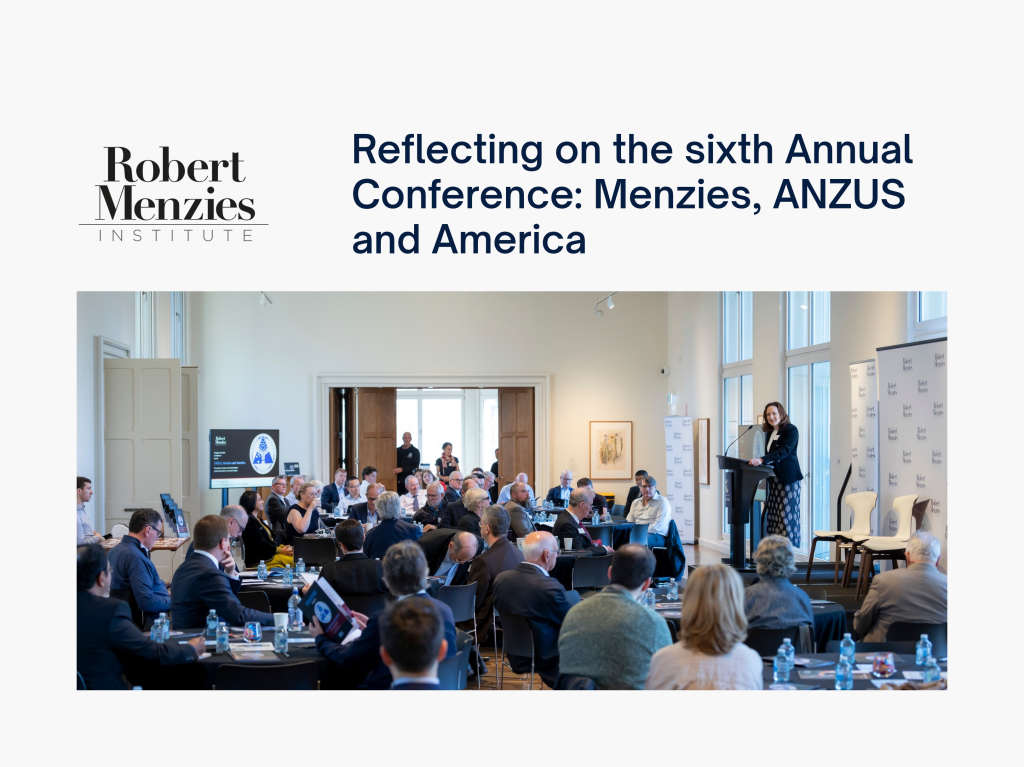
However, for the Robert Menzies Institute’s Sixth Annual Conference on ‘ANZUS, Menzies and America’ organised to mark this year’s 75th anniversary of the signing of Australia’s key security pact, we lucked out. Not only was it a triple anniversary, also coinciding with 250 years since the signing of the Declaration of Independence and 125 years since the inauguration of the Commonwealth of Australia, but it also corresponded with a notable uptick in the number of commentators questioning whether, after seven and a half decades, Australia should maintain its ongoing commitment to an Alliance with the United States.
Such scrutiny is healthy and welcome, but too often it takes place in an ahistorical vacuum, with little recognition of the lessons that the past can provide for the pressing challenges of today. After all, this is hardly the first time in which Australia has been unsure of the reliability and strategic convergence of our ‘great and powerful friend’ across the Pacific Ocean. Nor is it unprecedented for Australia to have to say ‘no’ to our defence partner, in a manner that defies the ‘deputy sheriff’ stereotype that has emerged since the Howard era.
Across the 23 papers delivered by academics from around Australia, America, the United Kingdom and even Japan, the conference explored numerous moments of alliance tension. These spanned disputes over the Japanese Peace Treaty, Korean war wool prices, Taiwan Strait stand-offs, Suez Crisis, West New Guinea Dispute, Southeast Asian regional cooperation and more. It also shed new light into how ANZUS ever evolved into what we now so unassumingly call an ‘alliance’ – a term Robert Menzies himself never used because he felt it exaggerated the level of commitment that the US had been willing to sign up for.
We even had a paper taking to story all the way up to the extremely contemporary issue of how the ANZUS Treaty may be applied to the present avalanche of cyber-attacks. Others went way back, unpacking how the United States first became interested in our region through unexpected developments like the Spanish American War, which led to American possession of the Philippines, and how the great republic was slowly coaxed out of a tradition of isolationism to become a replacement imperial protector.
Of course, any discussion of Australian unease towards the United States would be incomplete if it only focused on strategic interests. After all, much of the anxiety and news coverage has been related to political and cultural trends that many fear may end up being imported to our shores. This as well is nothing new – already in the 1930s Menzies was giving speeches complaining of the ‘uniformly stupid’ influence of American filmmaking, while on a trip to Washington in 1935 he wrote in his diary that ‘its corridors are cluttered with the statues of mediocrities, and its debates are beneath contempt’.
However, after greater exposure to the nuances and diversity of American thought, Menzies learned to be more discerning in appreciating the immense good, while still rejecting the bad. Conference papers likewise tracked how ideas emanating from the United States impacted the birth of Australian democracy, development of mid-century Middle-Class politics, debates surrounding the introduction of a Bill of Rights, a regulatory framework for satellite communications, and even the environmental concerns associated with supersonic flight.
The consensus reached was that despite America’s dominant position as a global hegemon, Australia has been remarkably resilient in maintaining its distinctive way of doing things. While we are hardly untouched, we are arguably less Americanised than comparable countries like the United Kingdom.
If there’s one thing that pervasive debates about American politics do achieve, it’s that they help to reveal that Australia does indeed have a unique and enduring identity and culture which come into sharper relief when we have a fellow English-speaking democracy to define ourselves against. The conference was therefore a perfect demonstration of the concept behind the Robert Menzies Institute’s Forging Australia series: that we can better understand who we are by way of deciphering the global forces that have shaped our nation.
The conference’s numerous insights are now available on our YouTube page and will be featured in our Afternoon Light Summer Series across the holiday period, before being fully realised in the upcoming Melbourne University Press volume Menzies, America and the Nation’s Vulnerability.
Interested in our Annual Conference? Check out our 2027 Call for Papers
Sign up for our monthly newsletter to hear the latest news and receive information about upcoming events.
Sign up for our monthly newsletter to hear the latest news and receive information about upcoming events.