19 May, 2026
Annual Review 2025-26: Preserving Liberal Heritage
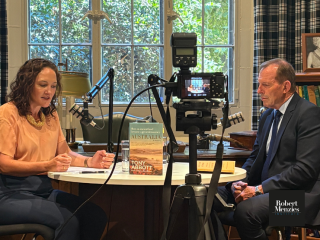
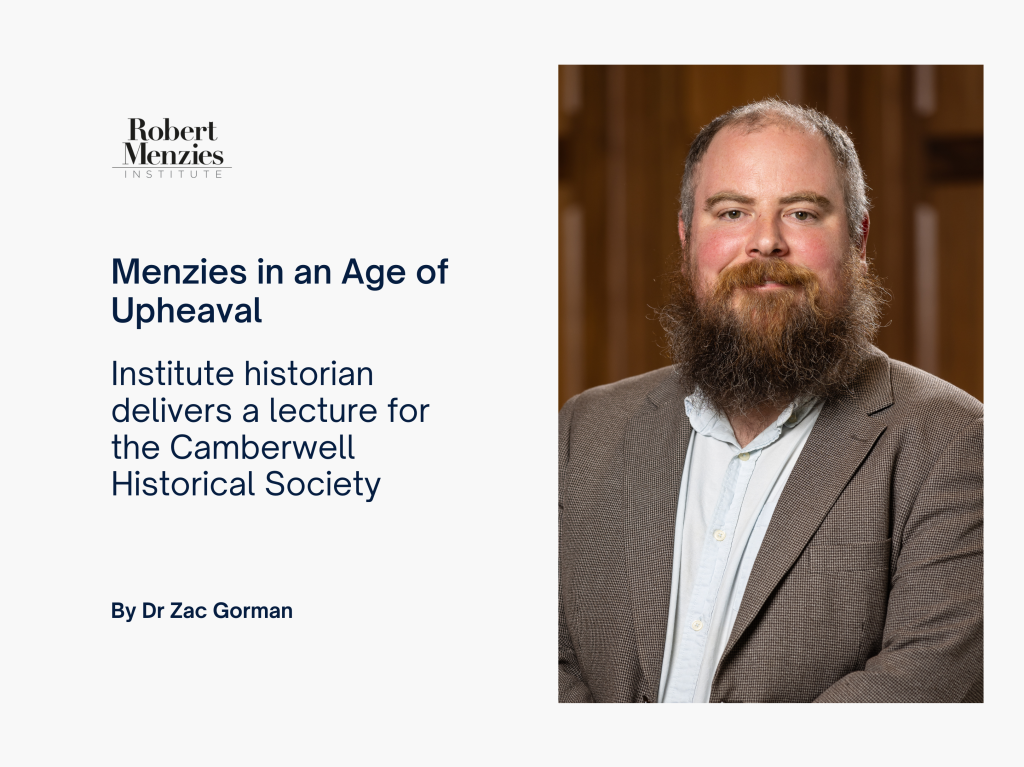
On Wednesday 27 May, the Institute’s historian Dr Zachary Gorman delivered a talk for the Camberwell Historical Society on the new book ‘The Menzies Legacy‘.
Below is the text of the speech he gave on the night:
It’s great to be back here in Camberwell to conclude our four part history of the Menzies era, by discussing our latest book The Menzies Legacy.
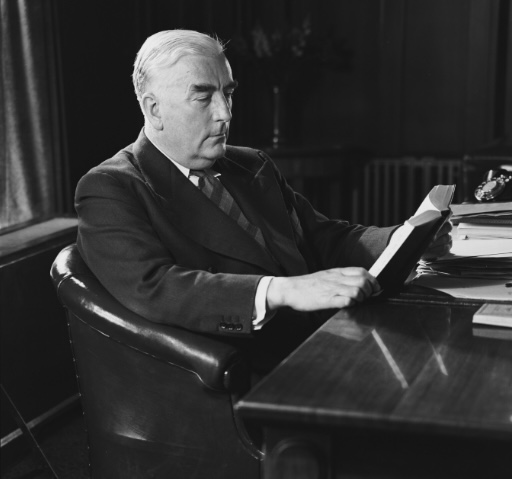
I remember when I first started working at the Robert Menzies Institute at the University of Melbourne five years ago, we were encouraged to only ever use photos of Menzies where he looked young, because everyone remembered him as being very old and a bit too old fashioned, and we were trying to change that, and depict a Menzies that was young and fresh and full of ideas. But after three other books, I think we’ve now earned the right to admit that he did eventually get old and to examine what he did in his last period in office and into retirement.
This is the part of the story where you get see the real juxtaposition of our tradition view of Menzies as a leader embodying stability and continuity, with how we remember the 1960s as a period of profound change. Such is the popular image of the decade, sharply contrasted with its allegedly stultifying predecessor in the 1950s, which you would more commonly associate Menzies with, that it has become virtually synonymous with protest, revolution, and the deliberate deconstruction of existing social mores.
Much as the ever-expanding suburbia of the Menzies era likely felt like heaven to a generation that had endured two world wars, a great depression, and the housing crisis of the 1940s; to their children, or at least some of the more vocal and prominent of them, it’s alleged to have become something of a prison. The physical manifestation of expectations, duties and pretensions to which the younger generation felt less bound. Something to be openly attacked by the likes of Germaine Greer, or lovingly lampooned by a Barry Humphries; both of whom fled to the same Britain that their ‘anachronistic’ and ‘anglophile’ prime minister was critiqued for admiring.
Yet when you look at the political record for Australia in the 1960s, this yearning for ‘liberation’ remained difficult to identify, let alone cast as a general phenomenon. Like its predecessor, the decade saw four federal election victories for the Coalition, with the only real difference being that two were closely fought (1961 and 1969), as opposed to just one (1954). In terms of both seat numbers and overall two-party-preferred totals, the desire for change was actually strongest in 1961, when Menzies was left with just a one seat majority after the Speaker’s chair had been filled. Casting doubt on any teleological assumption that such a desire built steadily over the decade, until the dam finally burst with Whitlam’s ‘It’s Time’ victory in 1972.
So the period covered in the book should not be seen as Menzies’s gradual and inevitable eclipse. But instead a dynamic era, marked by renewed geopolitical turmoil and a remarkable political bounce back, in which Menzies endured the most precarious parliamentary situation he had experienced since the one that had overwhelmed him and forced him to resign in August 1941. Indeed, one might even speculate that were it not for the close result, and a desire to hand over to his successor Harold Holt a more advantageous situation than that which Menzies had been plunged into when Joseph Lyons died in April 1939, Menzies’s retirement may well have come sooner.
Instead, he had to engineer a recovery at an early election called for November 1963 that allowed him to enjoy a series of unparalleled farewell honours. Including a knighthood in the exclusive Scottish Order of the Thistle, succeeding Winston Churchill as Lord Warden of the Cinque Ports, and an emotive retirement press conference. The irony is that these spoils of victory, and particularly the fact that they were lavished on Menzies while he was still in office, served only to reinforce the idea that he was already out of touch by the time he departed centre stage. At the age of 71, making him Australia’s oldest ever prime minister.
That the world that Menzies had been born into in pre-federation Jeparit, was long gone by the time of his exit in a national capital selected and built from scratch in the interim, is self-evident. To suggest that he fought a rearguard action to defend it, is to misunderstand how he mixed an instinctive conservatism with a hope that history meant progress. Provided people understood that we were perched on the shoulders of giants, & couldn’t build anything by ignoring the wisdom of our forebears.
As he described it in this quote I gave you last year, from which we get the word ‘procession’ the in the book’s title:
It’s only when we realise that we are part of a great procession, that we’re not just here today and gone tomorrow, that we draw strength from the past and we may transmit some strength to the future
But before we get into the details of the policies and historic episodes that are covered in the volume, it’s become something of a tradition that I begin these talks by drawing out some of the connections between Menzies and Camberwell during the period I’ll be talking about.
So I found this photo of Menzies at the Kooyong electoral office in Camberwell on 11 November 1963, lodging his forms for the very last time that he ever stood for federal parliament. Unfortunately, it is a bit too zoomed in to really recognise the Cookson Street location. But maybe some of you will be able to recognise the old style of parking meter as something that used to be quite common around these parts.
Sadly after he had finished his term, Menzies would snub Camberwell by deciding to retire in the relatively far off Malvern. But not only was that Haverbrack Avenue house bought for him by well-wishers, since he was too poor after a life dedicated to serving the nation to be able to buy one of his own accord, so he may well not have been the one to choose its exact location.
But I actually found a very good reason why Menzies might want to avoid spending too much time here. And that is that Camberwell had voted for prohibition in a local government poll in 1920, so you couldn’t buy a drink within the Boorondara council area, but you could in Malvern which had voted to reduce its number of liquor license holders rather than ban them outright. And although the prohibition polls themselves officially ended in 1946, their legacy of missing pubs and drinking venues turning various suburbs into temperance desserts would endure for decades, as would the wowser reputation attached to those suburbs.
While Menzies was no Churchill when it came to alcohol, he was certainly fond of a drink, and never more so than in retirement when he used to wait very patiently for the clock to strike 5.50, before pouring himself and his guest, who was often someone like Bob Santmaria or perhaps Malcolm Fraser, a large whiskey. So if the people of Camberwell did feel a little snubbed by the fact that Menzies didn’t choose to retire here, they only had themselves to blame.
All this talk of how Menzies enjoyed a tipple in retirement, brings us back to his rather surprising decision not to retire in 1961, even though he had already been in power for over a decade and held just about every political record you could imagine, and it did really seem as though after all that time the public were finally starting to get sick of the Coalition government. Particularly because they had finally started failing to do what all good governments must do and that is provide economic prosperity and consistent improvements in living standards.
Luckily for both Menzies and the voting public, the economic downturn known as the ‘credit squeeze’ we experienced at the beginning of the 1960s would prove rather temporary. This was due to a number of factors including French President Charles de Gaulle kindly vetoing Britain’s first attempt to join the European Economic Community, meaning that we could still export to Britain without being met by European tariffs, while our exports to Asia were also rapidly gathering pace as we experienced a new mining boom in minerals like coal, iron ore, and bauxite that would soon replace agricultural exports as the driving force of the Australian economy. And rather hypocritically, while we were benefitting from selling all our stuff overseas, we cracked down on import licensing, meaning that our manufacturers faced less competition, and the roughly 30% of people who were then working in Australia’s manufacturing industry could enjoy job security that they could only dream of today.
It all seems rather simple in hindsight, and that is why the Menzies Government failed to implement many of the reforms suggested by the extensive Vernon Commission into the Australian economy, the recommendations of which would presage some of the revolutionary reforms of the 1980s. Because by the time Vernon had finally completed his endeavour in 1965, producing a report that was no exaggeration almost one million words long, so more than twice the length of my own four volumes, Australia’s economy had recovered and everyone had moved on.
Although Menzies was later criticised for not doing more when it came to economic reform, we’ve previously covered how he was responsible for transformative policies like the introduction of the Reserve Bank, and this book has a chapter on the introduction of decimal currency, which took place less than a month after Menzies’s retirement on 14 February 1966 and was a great boon to the economy in making the arithmetic of transactions, and particularly foreign exchange far more simple.
The book actually dispels a very long-standing myth that Menzies wanted to name the new currency the Royal because he was such an incorrigible monarchist and anglophile. But it turns out the name wasn’t originally Menzies’s idea nor was he its main backer in cabinet. The name the Royal was actually a reference too clever for its own good. Because the new currency was to be worth ten shillings, or half of the existing pound, some history buff had suggested that it should be named after the original ten shilling coin from 15th century England which happened to be called the Royal. Needless to say, that the reference was completely lost on the Australian public, and the name had to be changed to dollar amidst a widespread public backlash.
But beyond these reforms, Menzies basically took the logical attitude towards Australia’s economy that if it ain’t broke you don’t fix it. And even when the Australian economy did finally break with the advent of stagflation in the 1970s, in would take Menzies’s prime ministerial successors a rather long time to find the political will to fix it, as it is with modern governments finding the political will to cut spending in order to drive down inflation.
While an economic recovery was the essential prerequisite for Menzies’s 1963 election victory and the grand farewell parties that followed it, the election campaign itself would be fought on two main issues: education and defence.
1962 saw the famous Goulburn Catholic school strike. When, in response to the New South Wales Government ordering St Brigid’s primary school to build a new toilet block which they could not afford or risk being shut down, all 6 Goulburn area Catholic schools temporarily closed their doors and encouraged their nearly 2,000 students to enrol in the local public schools.
Proving a very real point, that the government could either pay for some of their education in subsidising the Catholic schools, or they would have to pay for all of it within the public system. Hence, somewhat paradoxically, giving money to poorer private schools actually saved the government money overall.
The protest was the culmination of a near century long struggle, in which Australia’s Catholics, despite often being poorer members of society, insisted on maintaining their own schools to preserve their culture, religion and identity. And sectarian animosity combined with an ideological belief in ‘free, compulsory and secular’ education denied them any support in doing so.
By the early 60s, with the Catholic population expanded by the baby boom and new migrants from Italy and elsewhere, the free educational labour provided by the nuns and brothers who generally ran the Catholic schools was being completely overwhelmed, and there was a clear equity issue at stake in just how bad things were getting.
But despite the Labor Party traditionally being the home to a majority of Catholic voters, the ALP resolutely refused to back ‘state aid’ in part because of enduring animosity towards Catholics stemming from the Labor split of the 1950s. Indeed, when the Heffron Labor Government in New South Wales tried to do at least something on State Aid, they were barred from doing so by the party’s federal executive.
Ever the shrewd political tactician, Menzies seized the opportunity and introduced his own State Aid program, promising to fund the building of science blocks for both public and private schools during the 1963 election campaign, as a sort of thin end of the wedge that would open the door for the more comprehensive support that would follow. This has often been painted as a piece of political opportunism, particularly since DLP preferences had saved Menzies’s government in 1961. However Menzies had actually voiced his support for State Aid two decades prior, in a Forgotten People broadcast which made the front page of the Catholic Weekly and argued that:
‘It is to the eternal credit of these thousands of people that they have been prepared, for the sake of [their] deeply held conviction, to pay twice – once as taxpayers for the maintenance of the State schools, and the second time as parents for the maintenance of their children at Church schools’
A lot of people actually credit the introduction of State Aid for helping to break down the last vestiges of sectarian animosity in Australia, although there’s a chicken and the egg phenomenon there, because it would have been politically impossible to introduce the policy until the potential backlash from the Protestant majority had eased a little bit from itys peak earlier in the century.
On the other hand, the book also features a chapter arguing that Menzies’s State Aid policy was actually about the science blocks themselves, and the need to invest in science education in the aftermath of the launch of the Soviet satellite Sputnik and amidst the new digital age that was dawning. In this context, the policy was innovative not only in not discriminating between public and private schools, but also for not discriminating against girls schools, who had previously been excluded from private philanthropic efforts investing in science education. Because in the early 1960s, the view was still quite prevalent that women were not cut out to be high level scientists, but Menzies held a more progressive perspective on the matter.
Another major investment in technical education by the Menzies Government was the creation of numerous Colleges of Advanced Education, which were new tertiary institutions, that were a bit like a mix between a university and a Tafe, with clear vocational goals in what they were teaching their students. Many of the Colleges, like what became La Trobe here in Victoria, were later transformed into universities, on account of the Dawkins reforms overseen by the Hawke and Keating Governments.
However, while Menzies had done more than any other prime minister to invest in university education, introducing Commonwealth scholarships to give those with the talent and drive to undertake a university education the opportunity to do so, and overseeing a tripling of student numbers during his time in office. The decision to make Colleges of Advanced Education something less than full Universities had actually been a deliberate one. Because Menzies was concerned that if nearly everyone went to university the quality of the education provided would have to be lowered to such an extent that it would destroy what made university special in the first place.
So while he certainly wanted there to be more scholarships than the 25 that had been available when he won one to attend the University of Melbourne shortly before WW1, he still wanted there to be scholarships that you had to earn rather than a universal system like HECS. And while it is always controversial to say that some people should not go to uni, I would argue that Menzies has sadly been proven right in university standards and the university experience more broadly not being what they once were. Particularly in 2026 when many students get AI to write their essays, and professors get very little time to interact with the people they are meant to be teaching.
But back to the 1963 election, and how it was also shaped by defence issues. Because the early 1960s were a period of acute danger for Australia, because the so-called Konfrontasi between Indonesia and Australia’s ally Malaysia looked to escalate into a full-scale war between Indonesia and Australia. Indeed, though it was kept rather quiet, there were times when Australian and Indonesian troops were actively shooting at each other in northern Borneo. It’s often forgotten today that when the Menzies Government made the fateful decision to introduce conscription in 1964, its main motivation was not Vietnam, to which the government would not commit ground troops until the following year, but the potential need for soldiers in an existential conflict with Indonesia.
It is also often forgotten that the Sukarno regime was openly expansionist, having already taken over West New Guinea, and now eying Borneo. Also that Indonesia, while not being explicitly communist was home to the third largest Communist Party in the world, behind only Russia and China, and was receiving weapons from the Soviets.
So there’s a lot of historical amnesia going around, and this is due in large part to an abortive military coup in September 1965 which would lead to the ousting of Sukarno, the genocidal purging of the Indonesian communists, and the end of Konfrontasi. So in the end Australia’s no. 1 security concern disappeared virtually overnight.
But Konfrontasi remains the essential context for understanding the decisions surrounding defence which were made in the 1960s, which included a massive reorganisation and reequipment of the ADF. Leading to military spending as a percentage of GDP reaching a post war high of 3.84% in 1968, a number to bear in mind when you hear modern debates about the Albanese government trying to eventually get it up to 3% very far into the future.
This spending was urgently trying to get Australia into a position where we would be able to defend ourselves. Because President Kennedy had given an ominous warning to Australia’s External Affairs Minister Garfield Barwick, to whom he said that the American people had ‘forgotten ANZUS’ and were not prepared to go to war with Indonesia in defence of Australia should it come to that.
In the end, Australia came up with a shrewd plan to ensure that the Americans would be given a vested interest in our defence. And that was the integration of facilities based in Australia into the American communication and surveillance network. Starting with the establishment of the Northwest Cape Tracking Station in Western Australia, which would be named after Harold Holt following his disappearance, then Pine Gap in the Northern Territory, and Nurrungar in South Australia. Completely transforming the loose commitments of ANZUS into the tighter alliance arrangements of today.
The proposals for Northwest Cape became central to the 1963 election, since ever since the Labor split the ALP had been having an extensive internal debate over whether to continue to commit to the US and a hard opposition to international communism, or whether to instead pivot to an Australian version of isolationism and establish a nuclear free zone. The decision would go down to the wire, but it wouldn’t be one made by the party Leader Arthur Calwell nor Whitlam his deputy, but instead the 36 non-parliamentary members of the Labor Party federal conference.
On the night that the conference was voting at the Hotel Kingston in Canberra, the enterprising Daily Telegraph journalist Alan Reid managed to get a photograph of both Calwell and Whitlam standing outside, with the alternative prime minister waiting powerlessly to hear what his own foreign policy would be. The image was rapidly turned into a headline issue, as Reid dubbed the conference delegates ‘faceless men’, a term that has ever since been burned into the Australian political lexicon. But which spoke to longstanding concerns about the extent to which Labor’s methods may be anti-democratic in taking power away from the MPs that the Australian people had elected to parliament, and instead handing it to a narrow and sectional group union delegates. A situation that Whitlam would later be forced to rectify to make Labor electable once again by 1972.
The Liberal Party campaign seized on the image, and it helped secure a big election swing towards the government. Though notably, a large proportion of the seats it picked up were in Western Sydney where the State Aid issue had its greatest cut-through.
The book actually has a whole chapter on Western Sydney, using it as a case study to explore how Menzies was able to raise national home ownership rates from 50 to over 70% over the course of his term, greatly expanding Australia’s middle class and winning over the aspirational working class voters, who would later become known as “Howard’s Battlers”. Notably Howard himself and future prime minister Paul Keating were growing up in Western Sydney during this period, and the area did evolve to become something of a bellwether for the fate of future governments, because its population perfectly embodied Australian swing voters who were neither the wealthy members of what Menzies’s forgotten people broadcast had dubbed the ‘so-called fashionable suburbs’, nor rusted on trade unionists.
But while it is one of the great tragedies that the property owning democracy that Menzies did so much to built is now being destroyed through asset inflation and a market that’s extremely difficult for first homebuyers to break into, the book also avoids being too nostalgic about what the Menzies era expansion of suburbia actually looked like. Particularly in marginal areas like Western Sydney where new homes were often built in advance of basic amenities like running water. This may have been the great period of new and shiny consumer goods, but they weren’t of much use without a reliable electricity supply. So it would take some time for these rapidly built suburbs to evolve into places that were truly liveable by modern standards.
That being said, the book also has a chapter exploring the thousands of letters that Menzies was sent by ordinary Australians upon his retirement, and they were hardly nick-picky about what could have been better. Instead, they were incredibly grateful for the prosperity and modest comfort that he had provided. These were people who had lived through two world wars and a great depression, and couldn’t believe their luck in enjoying the sustained periods of relative peace and economic growth that Menzies had overseen. The letters express how they often saw Menzies as a fatherly, paternal figure, who made them feel safe and secure and had greatly increased Australia’s standing on the world stage. They certainly reflect an electorate that was far more satisfied with the workings of the democratic system than most people in Australia are today.
Of course, there were critics, often members of the intellectual elite like Donald Horne, who coined the phrase ‘The Lucky Country’ as a critique of how little the Menzies Government was alleged to have done over its 16 years in office. But not only was this irony lost on the ordinary Aussies that have since embraced the term as a positive monicker, it also reflected the underlying philosophy of a liberal approach to government.
Which is based on the belief that it’s not the role of the state to create grand plans and tell people how to live their lives, but instead the best form of government is one which creates conditions in which individuals can succeed in doing whatever it is they choose to do, and otherwise gets out of the way to allow them to make these choices. Of course, Menzies thought some choices were better than others, and encouraged things like family formation through child endowment and homeownership schemes, contributing to the birthrate reaching an all time high of 3.55 in 1961, another sharp contrast to the issues we’re facing today. So he wasn’t a complete libertarian nor a cultural relativist. But equally he was clearly not a socialist in believing that the government should be leading the way in everything.
The other central criticism of Menzies that would emerge after his retirement was that he should not have committed Australian troops, let alone conscripts, to the Vietnam war. But that decision needs to be judged in context. When it was made in April 1965 Konfrontasi was at its height, and Australia was desperate to convince the Americans to protect us from Indonesia after Kennedy had indicated that they were unwilling to do so. So we were basically making an insurance payment hoping to guarantee our own survival.
But nor was Vietnam considered to be a truly foreign war, remote from Australia’s strategic interests. Korea had been to some extent, which is why Menzies had initially deferred committing troops to that war because it was considered to be too far north and distant from Australia. But Vietnam was resolutely in our neck of the woods in South East Asia, far closer that it was to the United States, and Australians were initially relieved to see the Americans show so much concern about our region.
The book features a chapter demonstrating just how widespread support for the war initially was, and that there was even a network of pro-war organisations operating on university campuses to counter the anti-war protestors. There were people who were reasonably progressive, who painted the conflict as positive engagement with Asia and fighting for the defence of an Asian ally in South Vietnam. And then there was also the Catholic community, who were not only resolutely anti-communist because of all the atrocities and martyrdoms committed against priests and monastics in Spain and Eastern Europe, but who also saw the South Vietnamese government as a pro Catholic regime. Which indeed it was, resulting in many of the Indochinese refugees who came out under Fraser being Catholic, because they were associated with the regime and had to flee for their lives. Once here, they married Australians at a higher proportion than any other immigrant group, and still proudly fly South Vietnam’s flag to this day.
Arguably the real controversy with Australia’s involvement in Vietnam was not necessarily the initial decision in 1965, but rather the decision to continue to be involved as it became clear that the conflict was unresolvable and South Vietnam couldn’t be turned into a stable and consolidated pro-western democracy in the manner of South Korea. Which of course was not something that Menzies had to deal with because he had already retired in January 1966.
He spent his retirement years on the passions you might expect. Watching the cricket and his beloved Carlton football club – which famously installed a platform for him to be able to watch games at princess park from his Bentley after he’d suffered a stroke and was no longer able to cope with the regular seats. He also travelled to Britain to stay in Dover Castle as was his prerogative as Lord Warden of the Cinque Ports. Which by the way was a centuries-old position charged with the defence of the realm, in which Menzies succeeded Winston Churchill (who’d been symbolically appointed to the post during WW2), so Queen Elizabeth appointing Sir Robert to it really was a reflection of just how much Menzies had done for the British Commonwealth and how respected he was in Britain itself by the end. Then finally he also spent plenty of time in a university setting, serving as Chancellor here in Melbourne & lecturing for extended periods at the Universities of Virginia and Texas in the United States.
Menzies apparently got quite upset with the Liberal Party in his later years, famously voting for the DLP over John Gorton in 1969 or Billy McMahon in 1972, although he was rather fond of Fraser and one of his last forays into politics was to offer a defence of the Dismissal which Fraser had personally requested that he provide. So basically, he was voting for Santamaria and Fraser as the two men who bothered to come visit him in Malvern, on what was referred to as ‘Have-a-look’ avenue, because of all the gawking members of the public who tried to sneak a peek at their old prime minister.
While in 2026 there are questions as to how long the Liberal Party itself will survive into the future, that’s not a direct concern for us at the Robert Menzies Institute. Because at the end of the day Menzies legacy is so much broader than the party. It’s ANZUS, it’s homeownership, it’s universities, it’s all these things. But most of all, it’s the children and all their descendants that may never have been born without the safe and prosperous Australia he oversaw. Thank you.
Sign up for our monthly newsletter to hear the latest news and receive information about upcoming events.
Sign up for our monthly newsletter to hear the latest news and receive information about upcoming events.