25 Feb, 2026
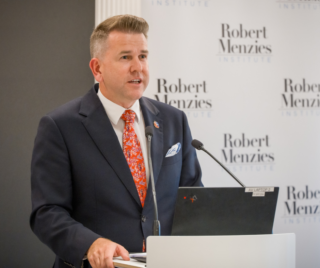
NSW Opposition Leader Kellie Sloane MP launches The Menzies Legacy in Sydney
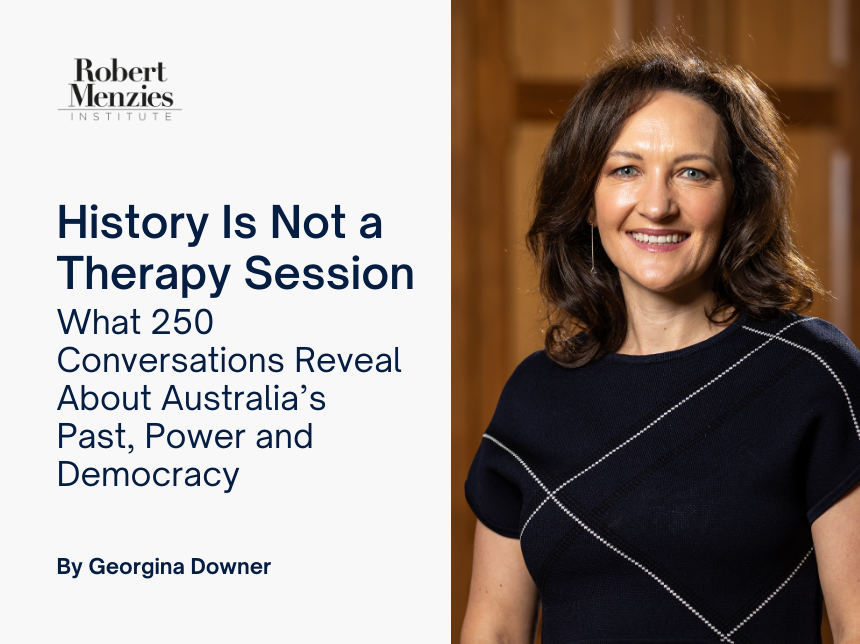
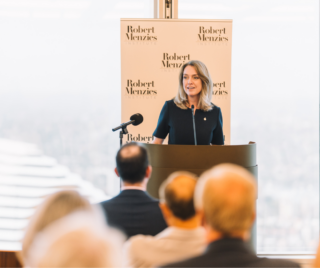
On 26 February 2026, Georgina Downer delivered this speech at the Union, University & Schools Club, Sydney.
“Ladies and gentlemen,
It is a pleasure to be here at the Union Club — an institution that, like the one I lead, understands something about history and tradition. About the importance of knowing where you have come from.
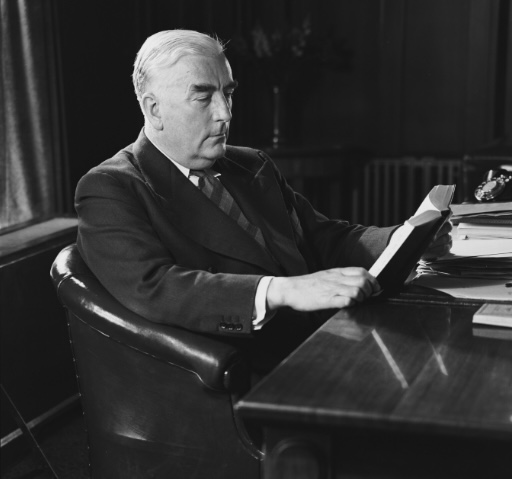
It’s particularly fitting to be here representing the legacy of Robert Menzies, given the rather colourful history between him and this Club.
The Union Club played an important role in Menzies’s career, but not exactly a supportive one. Being proud New South Welshmen, its members held a parochial scepticism about the Melbourne upstart, and the Club was known to be a hotbed of plotting against him during his first prime ministership and in the aftermath of the Liberal party’s electoral failure in 1946, when the adage ‘you can’t win with Menzies’ prevailed. Still, he got the last laugh, as when he started winning elections appointments at the club began to fill his appointment diary whenever he ventured up to Sydney.
So, with that history in mind, I want to argue something that some of you may find confronting and some may disagree with:
History is not a therapy session.
History can stir emotion — of course it can — but it is not a vehicle for present-day moral self-congratulation.
It is not a stage upon which we perform outrage at the immorality of our forebears. And it is certainly not a blunt instrument with which to batter the institutions that sustain us.
It is, rather, an inheritance. And like all inheritances, it requires stewardship.
What is the Robert Menzies Institute?
The Robert Menzies Institute was established at the University of Melbourne to honour Australia’s longest-serving Prime Minister — Sir Robert Menzies – and to study the ideas, institutions and individuals that shaped modern Australia.
At the heart of the Robert Menzies Institute’s mission is promoting the success of Australia’s liberal democracy and its values.
Not simply to archive the past.
Not simply to curate memory.
Not to cheer one side of politics over another.
But to strengthen the democratic inheritance that sustains us.
We are not a political party adjunct. We are not a think tank in the conventional sense. We are a research and public education institute dedicated to Australian liberal democratic history — particularly the ideas, personalities and institutions that shaped the 19th and 20th centuries.
And in five short years, I have come to a rather bracing conclusion:
Australian institutions have, by and large, given up on Australian history.
So, we decided not to.
What is Afternoon Light?
Out of that conviction grew Afternoon Light — our history podcast.
When we launched it, people asked: “Do we really need another podcast?” Isn’t everyone doing one?
To which I replied: have you noticed that British podcasts dominate the charts? The Rest Is History can pack out theatres. Americans revere their Founding Fathers and their Presidential libraries are genuine tourist attractions in the cities and towns where they are located. But Australians? We seem happy to consume everyone else’s history — except our own.
So, we built something unique.
A history podcast focused on 19th and 20th century Australia, told by historians, biographers, economists, diplomats, former prime ministers, civil society leaders — serious thinkers freed from slogans and moral fashion.
We have now recorded more than 250 long-form conversations. And at 50 minutes an episode, that’s a lot of talking – almost 210 hours of it – which I’m fairly sure qualifies for an endurance sport!
And when you have 250 extended, thoughtful discussions about Australia’s past, patterns emerge.
Serious people treat history with humility and as an irreplaceable source of vicarious experience.
They value evidence.
They value context.
They do not treat history as a stage for morality plays or political activism.
Who Have We Spoken To?
On Afternoon Light, I have spoken to historians about every single prime minister from Federation through to Bob Hawke.
I’ve spoken to most living leaders of the Liberal Party including John Howard, Tony Abbott, Scott Morrison, Brendan Nelson — and yes, even Alexander Downer. (I assure you that booking him was purely merit-based.)
I’ve spoken to biographers like Charles Moore on Margaret Thatcher, Troy Bramston on Gough Whitlam, Menzies and Hawke. Journalists such as Paul Kelly. Children’s authors like Jackie French. Former Governor-General Sir Peter Cosgrove. Popular historians Grantlee Kieza and David Hunt.
And I’ve spoken to literally hundreds of historians — many of whom rarely have the chance to speak beyond a lecture theatre. And of course, I’ve spoken to the wonderful Wendy Michaels about Millicent Preston Stanley, the Battleaxe in the Bear Pit.
The result is not polemic.
It is perspective, context, and understanding that we are part of a shared democratic story.
Why Bother with History?
I’m often asked — sometimes kindly, sometimes not — why bother?
Why talk about “dead white men”? Why revisit Menzies? Why dwell on federation? Why revisit Cold War diplomacy?
Some say Australian history is so boring, there are no revolutions, it’s just derivative of British history.
They say, surely the problems of today are unprecedented: social media, housing affordability, cost of living, Donald Trump, Xi Jinping, Vladimir Putin, fractured social cohesion, immigration pressures, universities producing what some call “junk degrees.”
But here is the inconvenient truth:
Most of our problems are not new. On so many of the issues I just listed, we’ve been here before.
History is an irreplaceable source of vicarious experience.
It tells us what worked. What failed. And why.
If we attribute Australia’s prosperity and democratic success to mere “luck,” we lose the ability to replicate it.
If we condemn the White Australia Policy without examining how it was dismantled, we lose the story of how entrenched prejudices can be overcome, and the debates that entrenched it for over 60 years.
If we remember only Vietnam and forget the Malayan Emergency and Konfrontasi, we study only failure but ignore success.
Liberal democracy depends on institutional memory.
Shallow history produces shallow policy.
Pride and Legitimacy
There is a deeper issue here.
If Australians are taught that their institutions are fundamentally illegitimate — merely the residue of a colonial regime — then why would they cherish them? Why would they feel responsibility toward them?
Democratic participation depends on legitimacy.
And legitimacy depends, in part, on historical understanding.
Pride in national history — properly understood — is not exclusionary. It is one of the conditions of belonging in a confident liberal democracy.
Menzies himself was inspired to public service by the sacrifices of his generation in war. He believed, as he once said, that a person with a sense of continuity sees himself “not as an accidental unit doomed to vanish in a few years, but as one of a great human procession.” influenced by those who came before, responsible for those who come after.
That idea is not conservative nostalgia.
It is liberal democratic continuity.
As Tony Abbott remarked on Afternoon Light in January, “A bad history doesn’t produce a good country.”
If we teach that our past is uniquely shameful, we weaken the present. And a nation that does not believe in itself will struggle to hold together when challenges arise.
The State of History in Australia
And yet, at precisely the moment when debates about our democracy and our social fabric intensify, historical literacy declines.
We are quite frankly living in an ahistorical age.
Today, enrolments in history degrees have fallen 23% since 2016. History academics have declined by 31% since 1989. Victoria is the only state offering Year 12 Australian History — with fewer than 500 students taking it. In 1972, that figure was 42%.
We have doubled academic staff and tripled enrolments since the Dawkins reforms — yet hollowed out the civic core.
Education is not neutral. The philosophy of the classroom today becomes the philosophy of government tomorrow.
History as Activism
Now let me be clear.
There is a place for gender history. Environmental history. Indigenous history. Post-colonial history.
But when these perspectives displace the broader unifying narrative — when the curriculum becomes an indictment of our country rather than an inquiry — we lose proportion.
The history taught in my childhood in the 80s and 90s neglected pre-settlement Australia. That needed correction.
But correction has tipped toward imbalance.
Students now learn extensively about dispossession and Frontier Wars, about the Stolen Generations and land rights — these are all essential chapters — yet often they learn almost nothing about federation, women’s suffrage, religious tolerance, the architecture of our Constitution, the building of a property-owning democracy, Australia’s statecraft in Asia. or the miracle of our peaceful democratic system.
In 1951, the Jubilee of Federation was celebrated elaborately. On the 125th anniversary of Federation on 1st January this year— there was silence.
Even when it’s not Australia Day which has fallen victim to a negative doom loop of shame— we seem unable to celebrate our country.
We can acknowledge wrongs without declaring the entire national story void.
Indeed, liberal democracy depends on that balance.
Lessons from 250 Conversations
So, what have these 250 conversations taught me?
That Australia’s success was not accidental.
Let me give you three examples on defence, Asia and home ownership.
My podcast with professor of National Security Studies at the USAF’s Air University Dr Augustine Meaher reminded us that the fall of Singapore was not simply Britain’s failure — it was Australia’s failure to invest adequately in its own defence.
Menzies learned from appeasement. Defence spending in the 1960s reached record levels because history had taught him that weakness invites aggression.
Mistakes remembered are not repeated. Mistakes forgotten are.
At a time when we are facing the most dangerous strategic environment since the 1930s, we find ourselves once again woefully underprepared and yet determined to ignore the lessons of history.
Or consider foreign policy and immigration.
Australia India Institute Fellow Teesta Prakash reminded us that India was the number one recipient of Australian aid from 1951 to 1969. Professor David Lowe at Deakin Univ spoke about how Percy Spender’s Colombo Plan was both moral and strategic — lifting living standards in Asia while binding our region together.
Colombo students humanised “foreigners” at a time of White Australia, whittling away racial prejudices.
Legendary economist Peter Drysdale and former diplomat Jeremy Hearder traced the deep roots of our engagement with Asia during the Menzies, long before it became fashionable and at odds with the usual narrative that it was not until Gough Whitlam came to power that Australia took Asia seriously.
My podcast with economist Saul Eslake showed that home ownership in the Menzies era was seen not simply as economic policy, but as the foundation of moral independence and citizenship. The housing crisis of the 1940s was met by the Menzies Government’s deep commitment to creating a property owning democracy in Australia. Once again we face a housing crisis but governments hand wring and do little to meet the aspirations of young Australians who just want what their grandparents had. That little piece of earth to call their own.
Universities and Citizenship
My podcast with Professor Michael Wesley reminded us that Menzies was perhaps the only prime minister to articulate what universities were for — not economic throughput, but democratic formation.
Our first universities in the 1850s were founded alongside responsible government. They were training grounds for democracy.
Menzies realised that for Australia to be a successful nation it needed to be an educated nation. His belief in a liberal education was central to his belief in our democracy. His 1950s reforms led to a doubling of Australian universities and a tripling of the number of students able to study under the commonwealth scholarship scheme.
Today, our universities have drifted from that Menzian mission. They are more like export hubs, pumping out degrees to thousands of international students while disregarding the domestic student experience. There is no sense of training the next generation of engaged citizens. Most students use AI to pass assessments, deriving little from their learning. We have lost sight of the whole purpose of a university that Menzies held dear.
The Stakes
Now without shared historical touchstones, we cannot unite.
When historical literacy declines, civic literacy does too.
We see antisemitism on campuses that have forgotten the lessons of the 1930s.
Australia, a country built on immigration and the successful integration of new migrants, is becoming less tolerant and welcoming, reneging on the extraordinary history of its post war migration.
We see overplayed diversity and underplayed unity, divisions over identity rather than unity over values.
We see institutions treated with suspicion rather than stewardship. Trust in our institutions is falling and many young people have lost faith in democracy as the preferred system of government.
History is not about feeling superior to the past.
It is about understanding it — in context, in proportion, in evidence.
To judge the past solely by today’s values is to assume that we are morally complete.
That is a dangerous assumption for any democracy.
Why This Matters Now
Liberal democracy is not self-executing. We learned in the early 2000s that liberal democracy was not the inevitable end of history, despite Francis Fukuyama’s claim.
Democracy depends on citizens who understand and believe in the institutions they inherit.
It depends on historical perspective — so we do not mistake every challenge for apocalypse, nor every disagreement for existential crisis.
It depends on knowing that each generation faces tests — and that previous generations faced theirs.
History does not excuse the past.
But neither should it caricature it or moralise it.
When we teach Australians that their inheritance is uniquely shameful, we should not be surprised if they treat it casually. If we teach Australians that they are divided by identities rather than united by values then it’s no wonder they can’t debate or disagree civilly nor find any common ground.
Conclusion
After 250 conversations, what have I learned?
History is not a therapy session.
It is an inheritance.
And if the Robert Menzies Institute’s mission is to promote the success of Australian liberal democracy and its values, then historical literacy is not optional.
It is foundational.
Because a democracy that forgets how it was built will not know how to defend it.
And a nation that cannot tell its story with confidence will struggle to sustain the institutions that depend upon it.
Ronald Reagan once said that the things that unite us must be more important than the things that divide us.
History — honestly told — is one of those unifying forces.
It reminds us that as Menzies said we are part of a procession — influenced by those who came before, responsible to those who will come after.
Thank you.”
Sign up for our monthly newsletter to hear the latest news and receive information about upcoming events.
Sign up for our monthly newsletter to hear the latest news and receive information about upcoming events.