15 Jan, 2026
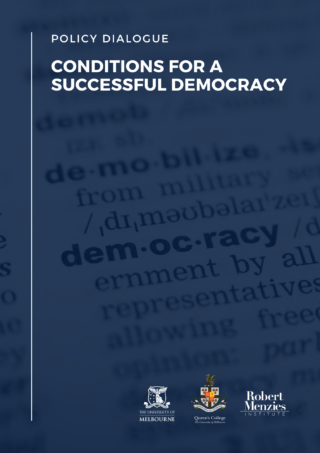
Policy Paper Release: Conditions for a Successful Democracy
By Georgina Downer, CEO, Robert Menzies Institute
It is often said that to be an Australian is to win the lottery of life. Despite this, over the last two decades, Australia Day has morphed from a day of celebration to a performative spectacle of the divisions in our society.
This is emblematic of an increasing sickness in our civic culture, where every important national debate descends into ad hominin attacks and echo chambers. The Adelaide Writer’s Week debacle is the latest example, but there are many others.
Australia is witnessing a concerning decline in civic participation, mutual respect, trust in institutions, productivity and social cohesion.
It is not good enough for us to think that Australia’s democracy will just look after itself. It needs nurturing, not just by political elites, but by the guardians of all our institutions across culture, education and the media.
So, this Australia Day, can we give bickering over symbols a break, and instead take a good, hard look at what is ailing our democracy?
The question has become more urgent in the face of the Bondi massacre and our disjointed and fractious institutional response to it.
In mid-December, our government refused to accept the country had a problem with growing antisemitism, calling the massacre a failure of gun control and intelligence instead. By mid-January, it had rushed through far-reaching legislation on gun control, hate speech and hate crimes with little public consultations.
For its part, the mainstay of the Opposition, the Coalition, has come apart on the passing of the said legislations and has ended its historic alliance.
Our civil society isn’t faring any better. Our oldest and most prestigious literary festival, Adelaide Writers’ Week, turned into a comedy show of invitations, disinvitations, re-invitations, boycotts, resignations and ultimately the cancellation of the event itself.
However, this sickness in our democratic culture is not unprecedented. We have been here before, during World War Two, and we overcame the challenge to our democracy. So, let’s learn from this legacy.
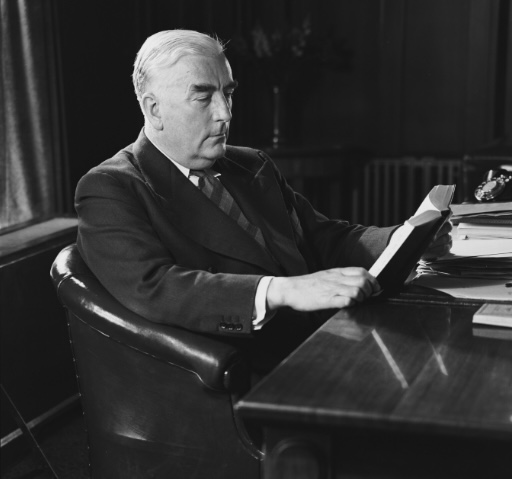
In his 1942 Forgotten People broadcast, Robert Menzies, Australia’s longest-serving prime minister warned us against viewing democracy in ‘purely mechanical terms’ instead of as a ‘living spirit’ sustained by civic virtue, moral equality and a sense of shared responsibility.
It is this ‘living spirit’ that gives legitimacy and force to the tools through which we exercise democracy – through parliament, courts, our civic and government bodies.
The reason why our institutions have failed repeatedly to deliver a united, coherent and effective response to recent challenges – be it COVID, climate policy, the Brittany Higgins fiasco, the Voice referendum, housing crisis or post-October 7 protests and terrorism – is because they frame their response in yet more laws and rules rather than through building dialogue, trust, respect and real accountability.
This was evident, yet again, in the manner in which the government responded to the Bondi massacre. Instead of welcoming a Royal Commission, it fought it. It failed to investigate or explain why existing hate speech and gun control laws had not prevented the massacre, yet amassed more powers for itself at the cost of individual and organisational rights. The end result is – no one is happy, neither Jews, nor Muslims.
History tells us that when leaders nurture the ‘spirit’ of democracy, not just its mechanisms, institutions deliver better personal and community outcomes for all.
When Robert Menzies retired from politics exactly 60 years today, he left Australia significantly stronger, richer, more educated, stable and united than when he came to office in 1949 at time of post-war austerity and the looming threat of Communism. He achieved this at a time of drastic social, economic and cultural change, with net migration into Australia of 2.2 million migrants.
Why was the Menzies-era able to accomplish all this, despite the challenges?
It was because the leadership of the time nurtured the ‘spirit’ of democracy.
The Menzies government invested in liberal education and liberal institutions so more Australians gained the skills of independent thinking and respectful debate. It removed barriers to people owning their own houses because it gave Australians a stake in their neighbourhoods and communities. It encouraged private enterprise because it didn’t want a populace beholden to the government.
In each instance, the institution served to build a ‘democratic culture’; they gave primacy to the betterment of Australians and not just their own preservation and perpetuation.
The Second US President John Adams famously said: “Remember, democracy never lasts long. It soon wastes, exhausts, and murders itself. There never was a democracy yet that did not commit suicide.”
If our democracy is to survive the future shocks in store of us, our leaders, institutions and civil society must focus on building the habits, attitudes and spirit of democracy, as much as its mundane mechanisms.
This opinion piece is drawn from a policy paper by the Robert Menzies Institute on the Conditions for a Successful Democracy, released for the 125th anniversary of Federation.
Download Policy PaperSign up for our monthly newsletter to hear the latest news and receive information about upcoming events.
Sign up for our monthly newsletter to hear the latest news and receive information about upcoming events.