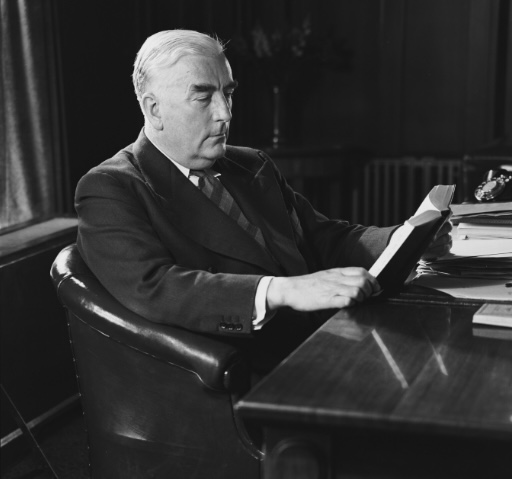
An Act controlling immigration to Australia was one of the first pieces of legislation passed by the new parliament of Australia in 1901. Sir Robert Menzies strongly disagreed with such discriminatory immigration policies, instead opting to embrace diversity as necessary. Below are resources to learn about the history of immigration in Australia and Menzies’ attitudes and beliefs.
An Act controlling immigration to Australia was one of the first pieces of legislation passed by the new parliament of Australia in 1901. On 23 December 1901 the Immigration Restriction Act came into effect. Its aim was to limit the number of non-British people migrating to Australia. This policy came to be known as the White Australia Policy.
The White Australia Policy reflected the attitudes of Australians at the time towards people who were not of British origin. Most Australians felt that, as the colonies had been initially settled by British people, even if many were convicts, Australia should remain true to its roots. In the years prior to 1901, the Australian colonies had experienced a significant increase in non-white immigrants, especially after the discovery of gold in the 1850s and the importation of forced Pacific Islander labourers in northern Australia. In the latter half of the nineteenth century these immigrants began to move from the goldfields and countryside into the cities and were willing to work for lower wages than white Australians and so were viewed as a threat.
The White Australia Policy had a rapid impact on Australian society by effectively barring non-British immigration. By 1947 less than three per cent of the entire Australian population had been born outside of Australia, Ireland or the United Kingdom. This was also fuelled by the government’s immigration programs which actively encouraged immigration from Britain to increase Australia’s workforce.
The Beginning of the End of the White Australia Policy
In the post-World War Two period the Commonwealth government’s attitude towards non-British migrants began to change. As Australia was rebuilding after the war there was an economic need to increase its population quickly and there were just not enough British people migrating for that to happen. So, the government began accepting migrants from southern and eastern Europe and some migrants from the Middle East and Asia. By 1960, migration had contributed greatly to the Australian population reaching the ten million mark.
Image Gallery
The Colombo Plan
Whilst it was two Labor party prime ministers, Curtin and Chifley, who first implemented the policy of non-British migrants coming to Australia, it was Menzies who first advocated the idea in 1943, and it was he and his government who continued this work from 1949 onwards and changed the shape of Australia.
On 9 January 1950 Commonwealth foreign ministers from Australia, the United Kingdom, Canada, Sri Lanka, Pakistan and New Zealand plus the prime ministers of Sri Lanka and India met to discuss foreign affairs in the region. The agreements arising from this conference became known as the Colombo Plan; a blueprint to co-operatively develop economic growth in South and Southeast Asia. Over time the Colombo Plan proved to be so successful that it expanded its member nations from seven Commonwealth nations to twenty-eight, including many non-Commonwealth countries. The plan also encompassed the Pacific region.
Australia played an important role in setting up the Colombo Plan which came into effect on 1 July 1951. This meant that the Menzies government began seriously engaging with its Southeast Asian neighbours. The ensuing educational programs run by Australia to develop a skilled workforce in developing countries saw many Asian students coming to Australia to study at our institutions. In fact, by the end of Menzies’ second term of office, in 1966, several thousand of these students had attended university in Australia. This in turn began to break down the racial barriers as young Australians began to see that their Asian counterparts had the same dreams and ideas as they did.
Menzies’s ‘Great Enterprise’
Even when Menzies was the Leader of the Opposition in the early 1940s, he argued that it was important for Australia to grow its population through immigration. He saw that the way to achieve this was to loosen the restrictions of the White Australia Policy which focused on British or AngloSaxon immigration to Australia.
When Menzies became Prime Minister again in 1949, he continued the work of the previous government of eroding the White Australia Policy. Menzies and his government actively supported immigration from elsewhere in Europe, focusing especially on people displaced by World War II and those whose countries had become part of the Soviet Union after the war, such as the Ukraine. Menzies seized the opportunity to secure Australia’s economic future and gain the workers, both skilled and unskilled, that would allow Australia to take its place on the world stage.
Furthermore, Non-European war refugees were allowed to remain in Australia and Japanese war brides were also welcomed. Plus, of course under the Colombo Plan, Asian students arrived to study in Australian universities.
In 1958, the Menzies government introduced a significant reform to the Migration Act which introduced a much simpler form for entry to Australia and removed the infamous dictation test. For decades the dictation test had been used as a barrier to prevent ‘undesirables’ and most Asian people from entering Australia by making them pass a dictation test in a European language chosen by the Immigration officer administering the test. The removal of the dictation test meant that migrants could now apply to come to Australia from any country and have an excellent chance of being accepted.
Menzies had a firm belief that a more open migration policy would bring prosperity to Australia by not only increasing its population but by enriching it through embracing other cultures. Between 1945 and 1965 over two million immigrants had arrived in Australia. Menzies’ policy would prove to be successful as migrants who arrived in this country during the 1950s and 1960s helped increase production, brought a young, skilled workforce to a country with an ageing population and generated a higher standard of living for all Australians, new and old.