25 Feb, 2026
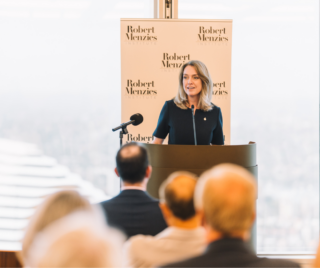
NSW Opposition Leader Kellie Sloane MP launches The Menzies Legacy in Sydney
On Wednesday 11 March, the Institute’s historian Dr Zachary Gorman delivered the annual McIntyre Lecture for the Kew Historical Society on the topic ‘Menzies’s Australia: 60 Years on’. Below is the text of the speech he gave on the night:
It’s great to be here tonight to be able to reflect on a project that has taken up 5 years of my life. To put that into some perspective, I’m only 35, so that means that I’ve essentially spent one out of every seven of my days on this earth thinking about Sir Robert Menzies. That’s one day a week.
Why on earth, you might well ask, would someone do such a thing?
Well firstly because I got a job as the historian of the Robert Menzies Institute, a prime ministerial library and museum dedicated to Australia’s longest serving leader, that was opened at the University of Melbourne in 2021 as a sort of scaled down version of the grandiose American Presidential Libraries.
But secondly because I’ve always been fascinated by Australian history, and Sir Robert not only did so much to shape that history, but in many ways his life story serves to embody the story of the nation that he led. Born in the tiny frontier town of Jeparit five years before federation, he would take advantage of scholarships and Australia’s culture of social mobility to rise to become a noted international statesman who could converse on a level of relative equality with US Presidents, British Prime Ministers and even Soviet Premiers.
In Britain, by the 1960s Menzies’s opinion could make or break governments, with Harold MacMillan being terrified that if Menzies spoke openly against his plans to join the European Economic Community it would be sure to incite a backbench revolt. Meanwhile, from an American perspective, Richard Nixon gave our longest tenured PM a glowing endorsement by writing that ‘If I were to rate one post-war leader… it would not be one of the legendary European or American figures, it would be Robert Menzies’.
At a time when the study of Australian history is in steep decline, with falling enrolment numbers, academic redundancies and a shrinking and distorted appearance in school curricula, telling Menzies’s story, not uncritically, but with a certain degree of national pride, helps to demonstrate the importance of history. Not only in teaching lessons from past mistakes, but equally in offering a sense of direction in which we learn to conserve and build upon past successes.
As Sir Robert put it when he laid the foundation stone of the National Library 60 years ago:
It is our duty in this generation so to store, so to attend to the books that are produced, that the future will learn something about us. We are learning from the past, we are learning from each other, we are helping to instruct and inform the future; this is the most tremendous process in the human mind, because it gives everybody a sense of continuity … It’s only when we realise that we are part of a great procession, that we’re not just here today and gone tomorrow, that we draw strength from the past and we may transmit some strength to the future.
This sense of continuity is a concept that Menzies spoke about frequently throughout his career, and may partly explain why his legacy has often been underestimated. Firstly, because he favoured consolidated progress over sweeping change, always seeking to preserve that which had proven its worth before experimenting with schemes that had yet to prove theirs.
Secondly, because much of what he achieved is so fundamental to the Australian way of life that we have often assumed it to be inevitable. Things like rising rates of homeownership, mixing high levels of immigration with the maintenance of social cohesion, ensuring steady economic growth that lifts real wages and living standards across the long term, and fostering a record high birthrate that reflects a population facing the future with hope and confidence.
It’s only now, when such achievements have started to unravel, that we begin to realise that we weren’t simply the ‘Lucky Country’ as depicted by dismissive critics like Donald Horne. It was the steady hand at the wheel that helped us navigate all manner of obstacles and prevent that luck from running out.
Over the rest of the talk I’m going to highlight some of the things that I’ve discovered over the course of editing our four-volume history of the Menzies era, which all told features some 61 chapters, each originally presented as a paper at the annual academic conferences which the Robert Menzies Institute hosts at the University of Melbourne each year.
But first I’d like to point out that just as I think that in many ways Sir Robert’s story is Australia’s story, it is undoubtedly a Kew story.
It was in this suburb that Menzies first began his political career by launching his successful bid for the East Yarra Legislative Council seat in 1928. And it was likewise here that he ended it 60 years ago last month, by formally telling the Liberal Party’s Kooyong Electorate Committee that he intended to resign from the Federal Parliament.
Many of Menzies’s most important political speeches were delivered in the old Recreation Hall, where as a young man Robert had attended patriotic dances aimed at raising money for his peers injured in the First World War. The only reason why the suburb wasn’t more prominent on the national stage was that the Hall had a rather limited attendance capacity, hence as prime minister Menzies would only begin delivering his election policy speeches in Kew from 1961, once the new Town Hall had opened.
But long before that, many of Menzies’s most productive years were spent in Kew. It was the suburb from which he became a household name, winning the landmark Engineers’ Case before the High Court in 1920, while still living with his parents in Wellington Street. It was from his Howard Street home that Menzies coordinated the founding of the Liberal Party in 1944, with daughter Heather recalling an onslaught of meetings, letters arriving and responses being written. Two years prior, Menzies had thought up the content for his famous Forgotten People radio broadcasts, which did so much to define the party’s political philosophy, while taking the long walk from Kew along Victoria Parade into his office in the city, the main form of exercise he could fit around his busy schedule.
On a personal level, Kew was the suburb where Menzies had married a 20 year-old Pattie Leckie at the Presbyterian Church, an occasion where her elegant choice of an ivory satin dress was somewhat overshadowed by a scheduling decision to tie the knot on a Monday night. It was in Kew that the two bought their first home, a block of land on what would become Grange Rd on which they specially built a house only to upsize a couple of years later. And it was in Kew, across a range of ever improving properties, that Robert and Pattie’s three children entered the world.
The Menzies did eventually pack up shop in August 1949, rather presumptuously selling their Howard St home ahead of the December 1949 election, at which a victory would see them move permanently to the Lodge.
But even though they never returned, instead opting for Malvern as a retirement residence, it was nevertheless in Kew that Menzies made what appears to have been his final public speech in September of 1974, accepting the conferral of the freedom of the city from the mayor. On that occasion, Menzies described Kew as a ‘quiet’ and ‘rather conservative’ ‘backwater’, which was precisely what he liked about it. He went on to explain that he and the locals shared common convictions, and didn’t have to ‘explain ourselves to each other’, and that it was this profound but unspoken support that had allowed him to achieve so much, because he never had to waste time looking over his shoulder for someone seeking to take the seat of Kooyong away from him.
And just before I move on from Kew, I should also say that he did have some contact with this very Historical Society. Which sent Menzies a letter of personal congratulations for the touching tribute he had given at Winston Churchill’s funeral in January 1965, an occasion on which he also served as pall bearer.
But of course Menzies didn’t start out as a figure of such international import, and if there’s one thing that telling his story in four volumes has revealed, it’s that his life and leadership took numerous twists and turns, and that the eponymous Menzies era arguably represented several different eras, which the books have labelled his watershed, ascendency, and legacy.
However, the story, much like the books, must begin at the beginning by taking a look at The Young Menzies and how from the start, his life seemed to intersect with the great events that shaped an emergent nation.
Back when Robert Gordon Menzies was born on 20 December 1894, not only had Australia not even had its first prime minister, but the whole process of federation had stalled since Henry Parkes had lost office in New South Wales in 1891.
The young Robert came into the world in the remote township of Jeparit in the western districts of what was thus still then the Colony of Victoria, and more specifically he was born out the back of the town’s general store which his parents James and Kate ran.
This small business was then hanging by a thread, as in the midst of both the 1890s depression and the federation drought, James had a habit of giving generous credit to struggling farmers, a policy which was far from financially remunerative, but which would reap its own rewards when James later entered politics and was able to garner the votes of a grateful district.
Despite the harsh conditions of the drought, Menzies would have something of an idealistic childhood swimming and fishing in what was left of Lake Hindmarsh and the Wimmera River. Here you can see an engraving by the artist Lionel Lindsay depicting a young Menzies fishing for the sceptre of the House of Representatives, with a bust of the highly influential Edmund Burke above him. I’m of the opinion that Menzies’s rural background and that idea of having a pioneering spirit from trying to tame the land were far greater influences on his worldview than has generally been recognised.
Another important influence would be Protestantism and the famous Protestant work ethic. The family was Presbyterian but because Jeparit lacked a church of that pervasively Scottish denomination, they instead attended the local Methodist congregation, where James served as a lay preacher. The young Menzies’s work ethic would be demonstrated at an early age when he would devour the books of the local mechanics’ institute, as well as religious works like the Pilgrim’s Progress.
There has been some debate over exactly how devout of a Christian the adult Menzies would grow up to be, but Christian ideals and concepts undoubtedly pervaded his outlook. Menzies came to believe that democracy was based on the Christian precept that there was in every human soul a spark of the divine, and that successful individuals had an obligation to give back to their communities. He also thought that individuals needed to maintain a moral independence that would allow them to make their own decisions and not be beholden to anyone – and this formed a cornerstone of his belief that both society and democracy would be better off if the vast majority of people were independent property owners.
This belief in freedom of conscience was a defining aspect of the long tradition of Australian liberalism, one to which Menzies was exposed from an early age – his brother Frank was even given the middle name of Gladstone after the iconic British Prime Minister, while Robert was given the more imperialistic Gordon, after General Charles George Gordon who had somewhat ironically gotten himself killed at the siege of Khartoum in 1885 after directly disobeying Gladstone’s orders. You can still find a large statue of Gordon near Parliament House in the city, as he was very much revered as a sort of martyr of empire in the late 19th century.
The Gladstone connection speaks to the fact that despite being of modest means, Robert was born into something of a political dynasty. His maternal grandfather John Sampson had been an active unionist who helped to found the forerunner of the AWU, and with whom a young Menzies would often debate the merits of left-leaning news articles from The Worker. Menzies’s contrasting Liberal-conservative views came from not just his father, but particularly from his uncle and political mentor Sydney Sampson, who in 1906 became the federal member for Wimmera, and sat as a crossbench Anti-Socialist Protectionist, refusing to join Alfred Deakin’s Party until Deakin had stopped relying on the support of the Labor Party.
The defining moment in Menzies’s early life was when a phrenologist came to the Jeparit public school, and after running his fingers over Robert’s scalp announced that the boy would be a barrister and public speaker. With an incredible amount of self-belief, Robert took the man at his word, even though the family could not afford any higher levels of education, hence Menzies would have to rely on winning scholarships to attend Grenville College in Ballarat, Wesley College in Melbourne, and then finally the University – which only had 20 scholarships available across the whole state of Victoria at the time. Menzies’s rapid success in these academic endeavours bred a certain arrogance and conceit that would be a defining flaw in his early years.
The other central flaw – at least as society at the time often saw it – was that Menzies failed to enlist in the AIF during World War One at a time when roughly 40% of all of Australia’s young men signed up. This decision was the result of a family conference, and made on the basis that the two eldest boys Les and Frank were already going off to war, and the family had also essentially lost their daughter Belle who had eloped with a soldier and was consequently separated from the family for a while. The parents wanted to keep Robert as a sort of insurance policy, particularly because his demonstrated talents indicated that he was clearly going places.
Menzies diligently obeyed his parent’s wishes, despite them inflicting a heavy social toll that would play into his later being blackballed from the Melbourne Club and openly denounced by Country Party Leader Earle Page. A desire to make up for this lack of military service seems to have been the central impetus behind Menzies’s entry into politics, as he would later describe that he quote ‘just had to do something to justify my existence’.
That Menzies personally wanted to enlist is suggested by his participation in the fierce debates over conscription that took place at the University of Melbourne during Billy Hughes’s two plebiscites on the issue.
But while Menzies was hardly the first nor the last uni student to take an active interest in the hot-button political issues of the day, and I should know working on campus, what’s remarkable is that shortly after he graduated with his Law Degree, Menzies was already shaping those issues by overturning how the High Court interpreted the Constitution. Ever since federation, the court had assumed that the constitution was intended to be a federal compact, and therefore it needed to uphold the power of the states on a level of relative equality with that of the Commonwealth. But the Engineers’ case, which Menzies won at the tender age of 25, overturned that assumption, and paved the way for the Federal Government to take ever growing control over industrial relations and a whole host of policy areas.
The great irony was that while Menzies had accepted the case on the basis of the ‘cab rank’ rule, he would actually spend much of his political career fighting against referendum proposals which tried to expand the scope of the federal government. Most notably the 1944 14 powers referendum, which would serve as the springboard for the founding of the Liberal Party.
Engineers’ earned Menzies national fame, and meant that he could basically charge what he liked for court appearances from the on. But while he could undoubtedly have gotten rich at the Bar and likely ended up on the High Court himself, he ultimately decided to trade it all in for a crack at politics. Beginning tentatively with a Legislative Council seat, before moving into the Lower House and becoming Deputy Premier of Victoria in the Government of Stanley Argyle.
By the time that the Great Depression hit, Menzies had become not just a popular public figure, but also a powerful backroom dealer. He would play a central role in convincing Federal Opposition Leader John Latham to step aside for Labor defector Joseph Lyons, precipitating the formation of the United Australia Party that would hold office for almost a decade until Menzies himself resigned as PM in August of 1941.
The choice of a Catholic leader in Lyons was unprecedented for the conservative side of Australian politics, which had previously been associated with the prevailing Protestant ascendency in what was then still a nation marked by deep sectarian divisions. But despite being a product of that culture, these were not prejudices that Menzies ever subscribed to, and he had shrewdly judged that Lyons would be the perfect salesman for a message of fiscal restraint amidst the deepening economic crisis. After all, Lyons had been plunged into poverty during childhood when his father had recklessly bet all the family’s money on the Melbourne Cup, and he consequently thought that budgets needed to be balanced and debts repaid as a matter of deep conviction.
Menzies’s backroom dealings mean that he can lay claim to having helped to found not just one but two major political parties. However, there was an important difference between the UAP and what would become its Liberal successor, and that was that the former was formed to deal with a specific crisis rather than to represent a coherent and enduring set of principles – however poorly the Liberals may be doing that at the moment.
In essence, the UAP was Joe Lyons and when he passed away on Good Friday 1939, both the party and the Coalition quickly began to disintegrate. I won’t spend too much time on Menzies ill-fated stint as a wartime Prime Minister, even though it was arguably vital in getting the nation ready for the eventual conflict with Japan. For if anything its early termination proved serendipitous, as it not only humbled Menzies after a lifetime of easy victories, but it also gave him time to reflect on why he had entered politics, as he contemplated giving it up entirely.
My own view is that Menzies rediscovered his passion for politics after he was asked to deliver a series of radio broadcasts on 2UE beginning in January 1942. These have been made famous by The Forgotten People address & it’s association with the founding of the Liberal Party, but my research suggests that they were never initially intended to be political.
Here you can see some early advertisements for them from the Wireless Weekly, which was a magazine which functioned as a sort of a TV Week for radio, and the emphasis is on Menzies as a recently retired war leader, who had spoken intimately with Churchill and Roosevelt, and who would therefore be able to speak with an insider’s knowledge on war matters. In this format, the early broadcasts became a smash hit, which were relayed to radio stations in America and around the Commonwealth, and had their contents reported on in both the New York and London Times.
This was at a time when the Japanese were rapidly advancing and the world’s eyes turned towards the Pacific, hence Menzies’s broadcasted views were repeatedly cited even in debates in British Parliament. It is only with the Forgotten People, which is actually the 20th broadcast in the series, that they became politically focused. The Forgotten People starts with the line ‘Quite recently, a bishop wrote a letter to a great daily newspaper’ and basically Menzies had gotten so angry at an article that left-leaning Anglican Bishop Ernest Burgmann had published in the Sydney Morning Herald that he felt compelled to talk about it on air. And to me, it was that sort of spontaneous op ed passion which brought Menzies back to life as a political animal. There followed broadcasts looking at each of Roosevelt’s four freedoms (of speech and worship and from want and fear), examinations on the ‘Nature’, ‘Sickness’, ‘Achievements’ and ‘Task’ of democracy, and explorations of questions like ‘has capitalism failed?’ and ‘is inflation a bogey?’.
By the end of 1942 Menzies had put together a coherent political philosophy, which was grounded in tangibles like the family and the home rather than being rigidly dogmatic or utopian, but which would form the blueprint for a postwar democracy based on widespread homeownership and somewhat regulated but otherwise free enterprise. While in office, Menzies had been frustrated by Labor’s call for a plan for postwar Australia which he thought was a distraction from the more urgent task of winning the war. But out of office, he had almost inadvertently ended up writing such a plan, albeit one which emphasised the role and freedom of the individual, rather than the directing power of the state
Which brings us to The Menzies Watershed, so-called because of the sharp contrast between the visions for post war Australia offered by Menzies and his Labor opponents. It’s important to realise that the war brought forth a style of politics that was very different from the mundane retail contests we’ve seen between parties in the modern era.
There was a lot of philosophising about what sort of Australia were we fighting for? Particularly considering the prewar world had been marred by the Depression, & people openly courting with fascist and communist alternatives to democracy.
Labor’s answer was called post war reconstruction, and it involved the federal government keeping the extensive powers it had garnered during the war, and using them to create greater economic security and a more centrally planned nation.
There were aspects of this that Menzies supported, like the goal of full employment and the Social Services referendum of 1946.
But he drew the line at the outright socialist aspects of the agenda, including Chifley’s attempts to have the government monopolise banking, air travel, healthcare and in some ways even housing. Indeed, the 1940s saw a now forgotten housing crisis quite similar to that which we are experiencing today. Understandably, few houses had been built during the Great Depression, and those that were tended to be of low quality and were often designed to be temporary. Then during the war building materials that would otherwise have been utilised for housing were diverted to the war effort. So by the late 1940s you basically had two decades worth of pent up demand, which would soon be exacerbated by the rapidly rising birthrate of the baby boom, and the great wave of postwar immigration.
In these circumstances the Chifley Government made it clear that its solution to the crisis would be to have the average Australian worker directly rent their house from the government, in a system which would have had some similarities to that of the Soviet Union. Infamously during a debate over housing policy, Minister for Reconstruction John Dedman would say explicitly that Labor did not support fostering private homeownership, because it did not want to turn the Australian people into quote ‘little capitalists’, and this was a line that Menzies seized upon and would cite directly in both his 1946 and 1949 policy speeches.
But the real political godsend was Chifley’s attempt to nationalise the banks, which galvanised a broad section of the Australian electorate from white collar bank employees to ordinary customers concerned that they would be robbed of the freedom to chose between competitors. They were joined in their protests by members of Australia’s aviation industry, who were likewise aghast that Chifley was attempting to nationalise flight across the continent, since before the war we had one of the world’s most flourishing private aviation industries. Even famous aviatrix Nancy Bird, after whom the new Sydney airport is named, joined a grassroots and specifically female movement dubbed the ‘Australian Women’s Movement Against Socialisation’ which boasted thousands of campaigners.
Both bank and airline nationalisation were ultimately declared unconstitutional by the High Court, but they were nevertheless taken as emblematic of the Chifley Government’s intent to control and regulate every aspect of the economy and ultimately people’s lives. As Menzies’s 1949 election poster, printed nearby in Camberwell explained, it was a battle for freedom for producers, consumers, and even workers who would have little in the way of bargaining power should the federal government become the sole employer.
More mundane but nevertheless telling issues were coal strikes leading to widespread blackouts, which got so bad that even the ALP resorted to sending in the army to break the strike, and the Chifley government’s maintenance of petrol rationing which greatly restricted the ordinary person’s ability to use their car. The latter was a very tangible restriction on personal freedom, which would be immediately contrasted by the great age of motoring that Menzies and the 1950s would usher in.
It was a potent electoral cocktail, and one made all the more effective given Menzies had persistently outlined a clear alternate philosophy via his wartime broadcasts. Moreover, the positive swing that Menzies achieved at the 1949 election would be exaggerated by the Chifley Government’s decision to greatly expand the size of parliament – which was the first time this had occurred since federation. These changes allowed vulnerable members to protect their seats, but it also meant the creation of many new electorates which the Liberals took and would hold onto for many years to come. An entire new generation of young and enthusiastic parliamentary members, most of whom had been active servicemen, came to Canberra and were dubbed the ‘49ers’.
However, this new crop of fervent anti-socialist Liberals were to be somewhat disappointed by Menzies once in power. For although the new Prime Minister had successfully halted the worst of the socialist agenda and promptly abolished the Department of Post-War Reconstruction, he had no intention of throwing the baby out with the bathwater. He kept on experienced public servants even if they were left leaning, allowed them to continue to pursue Keynesian economic management and the objective of full employment, kept investing in expensive nation-building projects like the snowy hydro, and kept up and even accelerated the boom of post war migration. Many of these decisions should not have been surprising, since the first experiments with Keynesian economics had actually been initiated by the wartime Menzies government, and Menzies had advocated for broadening migration long before Labor adopted the policy, since traditionally the trade unions were immigration’s main opponents.
But there were also philosophical compromises that came out of necessity, specifically the need to reintroduce some unsavoury economic controls to deal with the inflationary effects of the Korean War wool boom – caused by the Americans buying up so much material for the making of uniforms that it completely destabilised the Australian economy. In other areas Menzies was more economically liberal than we remember him. One of the ways in which he ended up boosting homeownership from 50 to over 70% over the course of his tenure was to remove sales tax from building materials, while he also sought to sell off a number of archaic government owned assets such as a shipping line, oil refineries, and even a Commonwealth network of whaling stations. So Menzies engaged in privatisation, although back then it was referred to as de-socialisation.
The point is that it was a nuanced picture, that does not easily translate when modern politicians try to use Menzian precedents in our present context to argue for or against so-called neoliberalism. Menzies was small government for the time, but he would not have been considered small government in the 1980s, but then again he never encountered the debates of the 80s so we will never know how he would have reacted to them.
Another way in which this watershed period fundamentally shaped Australian history is that it saw the birth of the enduring & oft-times controversial Australia-US alliance with the signing of the ANZUS Treaty in 1951, so 75 years ago this year.
Many people assume that the alliance was the inevitable outcome of World War II & John Curtin’s famous ‘look to America’. But after the war, the Americans had been very clear that they wanted to avoid ongoing entanglements in the region, because they were already so committed to Europe via NATO.
It took careful negotiations for Australia to secure a treaty, and the key bargaining chip was actually us agreeing to a so-called soft peace treaty with Japan that would avoid the retaliation of Versailles and allow her to rebuild her economy, in the hope that Japan would become a prosperous beacon of capitalism within Asia.
As you can imagine, after all the atrocities that had been committed against Australian prisoners of war, supporting Japan’s prompt rehabilitation into the family of nations was extremely controversial, and Labor would oppose it every step of the way. From the signing of the peace treaty in 1951, to allowing in the Japanese brides that had married our occupation forces, to the landmark Commerce Agreement signed in 1957.
But the Menzies Government was lucky in having so many ex servicemen including ex POWs in its ranks, who were able to sell the policies not only as in our strategic interest, but also as a powerful display of Christian forgiveness.
In the long run, developing an economic relationship with Japan would prove vital to Australia’s prosperity, particularly as our trade with Britain declined and it ultimately decided to join the European Economic Community.
Another key overlap between Cold War strategy and Australia’s burgeoning engagement with Asia was the Colombo plan. A massive aid and technical assistance package which sought to assist the nations of the Indo Pacific in their economic development. Like with the peace treaty, this operated under the premise that the best antidote to communism was prosperity, and while it involved multiple donor nations not just Australia, it was said to be the brainchild of Percy Spender, who raised the concept at a meeting of Commonwealth Ministers in Colombo in 1950.
The most outwardly visible, and certainly the best remembered aspect of Colombo was the student program, which allowed sponsored Asian students to come to Australia and study. To do so they would be allowed to bypass the still existent White Australia Policy, as were a far higher number of fee paying Asian students who followed in their wake. It proved to be an incredibly powerful instrument of soft diplomacy, ensuring that future leaders of some 15 different countries had a personal connection towards and positive memories of Australia. Indeed, there have been ministries of the Malaysian government in which every member had been a former Colombo plan student.
Spender’s successor as External Affairs Minister Richard Casey explained that the aim of the student program was to quote ‘break down prejudices and misunderstandings on both sides’, and indeed it would work better than expected in this regard, because the Colombo Plan is now considered to be an important factor in helping to erode the White Australia Policy. Not only was a generation of future Asian leaders studying in Australia, but they were studying side by side with Australia’s future leaders, who therefore grew to reject the racist assumptions held by many of their parents. Moreover, the Colombo plan students often ventured off campus and their activities were widely reported in the news, hence it was not just uni students who were being exposed to a diverse range of intelligent foreigners, but the general electorate as well.
One of the defining aspects of the Watershed period was that it was by no means clear that Menzies would ever become our longest serving prime minister. Indeed, when the newly formed Liberal Party lost its first election in 1946, many people, particularly in Sydney, reached the conclusion that he was an electoral liability.
Even once in power, the Menzies Government experienced some periods when the polls turned against it. Particularly in the aftermath of the Korean War wool boom, where an acute bout of inflation prompted the so called ‘horror budget’ of 1951.
But Menzies was lucky that this came shortly after he had won the 1951 election, so he had a full term to recover before going to the polls again. Shortly before that 1954 contest came the Petrov defection which revealed an extensive Soviet spy ring in Australia and appeared to confirm all of Menzies’s warnings about the internal dangers of communist espionage. The conspiracy theory that Menzies’s concocted or manipulated the affair for his own electoral advantage has long been debunked, but there remains plenty of ‘what ifs’ regarding the result of the election had Petrov not stolen the headlines. Polls suggest that it would have been a close run affair, but by no means a clear Labor victory. Indeed, outside of our series, academic Bridget Brooklyn has argued that Petrov was not all that central to the result, hence the Coalition may well have won regardless.
What is more certain is that Labor Opposition leader Herbert Evatt did not handle the defeat well, and suffered something of a mental breakdown in which he came to believe the conspiracies. Infamously, he even wrote to Soviet Foreign Minister Vyacheslav Molotov, famous from the Molotov-Ribbentrop pact with the Nazis that ushered in WW2, who unsurprisingly agreed that Petrov had been a hoax.
It was Evatt’s downward spiral that would precipitate the Labor split, in which anti-communist Catholics in both Victoria and Queensland left the ALP and began directing their preferences to the Coalition, giving Menzies an unprecedented electoral advantage.
Menzies became Australia’s longest serving prime minister as early as 30 November 1954, meaning that he still had more than 11 years to go in building an unassailable record. The real question was what was he going to do with his electoral good fortune?
But of course, in the second half of the 1950s the run of luck was not just his, it was enjoyed by just about everyone who didn’t happen to be occupying the Opposition benches. It must be remembered that Menzies was dealing with an electorate that had endured two world wars and a great depression – people who had already lived enough of history and were more than happy to enjoy some comparative peace and quiet. For the Jubilee of Federation in 1951, the Menzies Government gave out a booklet explaining the Australian story to schoolkids across the nation, and in the foreword he wrote for it the prime minister basically had to admit that the our first 50 years as a unified country had proven to be pretty rough.
In contrast, the 1950s saw an Australia in which people felt more secure and content to lay-down roots, as demonstrated by the birthrate reaching a record high of 3.55 in 1961. Meanwhile, the government oversaw a record immigration program, which created little of the tensions surrounding the issue today because the people who were already here had little difficulty affording homes and wages were consistently increasing.
Prosperity, urbanisation, the triumph of the automobile, and new consumer technologies were being enjoyed across a wide range of the electorate, particularly an ever expanding middle class who were ‘Forgotten People’ no more. Of course this wasn’t just luck, the Commerce Agreement was beginning to pay off in new markets for Australian exports, and by the beginning of the 60s a new mining boom was in the offing, providing much needed diversification to an economy that had still been riding on the sheep’s back. Meanwhile, in 1959 the government passed legislation to found the independent Reserve Bank, that we’ve been nitpicking the decisions of ever since.
Having got the economy right and being insulated by DLP preferences, Menzies was able to pursue passion projects that were explicitly not vote winners. Namely reforming and expanding Australia’s university sector, and developing Canberra as a true national capital.
When it came to the former, it is no exaggeration to say that Menzies is responsible for making university education a ubiquitous part of Australian national life. Both through introducing merit-based Commonwealth Scholarships to ensure those with the talent and the drive to pursue higher education were not robbed of the opportunity to do so. And through his adoption of the recommendations of the Murray Report, which would provide guaranteed funding without interfering with academic freedom and imposing government priorities as to what people should be forced to study.
University education has become so central to our national life, that we now often forget that it was once subject to an Australian propensity for tall poppy syndrome. Up until World War II, most branches of the Australian Public Service seldom hired university graduates, as to do so was assumed to favour the well-off. And indeed even many members of parliament in the Menzies era held no degrees, which was sometimes a point of tension between Menzies and his more practical-minded deputy and Country Party Leader Arthur Fadden. That things have changed so much since then is in large part due to Menzies, who led a personal crusade for the universities that was of little direct interest to his Cabinet colleagues.
Likewise, Menzies can take the credit or perhaps the blame, for the growth of Canberra from bush capital into a permanent city. On this issue, Menzies was undoubtedly a convert. When he was initially invited by prime minister Lyons to stand for the seat of Kooyong in 1934, Menzies declined the offer because he was so loathe spend time away from his beloved Melbourne or indeed Kew. It was his wife Pattie who had to goad him into making the decision to go where he could make the greatest contribution to the nation.
Likewise, it was female voices who persuaded him to invest in Canberra. After Menzies’s daughter Heather gave birth to granddaughter Edwina on 6 March 1956, and then had to deal with the unpleasantness of trying to push a pram around the underdeveloped ACT, she made its inadequacies very plain to her father. If you’ve ever wondered why Canberra now has such extravagant footpaths, it was in order to rectify Heather’s persistent complaints.
In his own words, Menzies became an ‘apostle’ for Canberra, believing that having a capital ordinary citizens could be proud of would go a long way towards breaking down parochial state prejudices that had proven remarkably enduring since 1901. He even sold his Melbourne home, and relocated permanently to the Lodge for his second stint as PM. And while he may have continued to miss the excitement of regular attendance at Carlton Football Club games, by introducing the tradition of hosting Prime Minister’s XI cricket matches, he was able to replicate at least some of Melbourne’s vastly superior entertainment offerings.
The Menzies Government was responsible for the construction of such Canberra landmarks as the National Library, defence buildings in Russell, the Royal Mint, and perhaps most impressively Lake Burley Griffin itself. A beautification so costly that the Treasurer tried to defy his PM and cut it out of the budget, only for Menzies to insist that a capital city without a water feature was no capital at all.
Even in policy areas that would not be traditionally associated with Menzies, progress towards modernity was being made. Namely the gradual dismantling of White Australia and improving our treatment of Indigenous Australians. On the former, his actions proved to be far more reformist than has hitherto been appreciated. Not only was Menzies one of the earliest voices supporting a broadening of Australia’s immigration intake to encompass the greater diversity that would characterise post-war migration, but he also greatly liberalised – admittedly without removing – the restrictions that remained in place for prospective Asian migrants.
On coming to power in 1949, the Menzies government overturned a large number of deportations made by Labor’s Immigration Minister Arthur Calwell – the most infamous of which involved Asian refugees who had fled Japanese persecution by coming Australia. And his government also introduced a number of exemptions allowing Japanese war-brides to settle here, and Asian international students to come to Australia in vast numbers to study.
Likewise, it was the Menzies Government which abolished the infamous Dictation Test in 1958, at a time when Evatt as Opposition Leader was insisting that it be kept as a mechanism of last resort. Indeed, while Labor had introduced the first phases of our post-war immigration program, by the late 1950s they had reverted back towards to a traditional trade union opposition to the wage competition excessive migrants created. And it was the Menzies Government which had to defend the immigration program from people who had erstwhile been its architects.
On Indigenous policy, the Menzies government was often slow to act, but the movements that it did make were at least in the right direction. The Commonwealth Electoral Act of 1962 gave all Indigenous Australians the right to vote in federal elections, when this had previously been a right granted on a state by state basis. Menzies appointed Paul Hasluck as Minister for the Territories responsible for overseeing the administration of the NT – a man with such an interest in Indigenous policy that he had written a whole masters thesis on the topic at the University of Western Australia in the 1930s. Hasluck would work tirelessly to foster greater equality and opportunity, removing any explicit racial categories from the territory’s laws. Although because he felt that the path to equality and opportunity was through assimilation, his reforms are admittedly no longer viewed as being as progressive as they appeared to be at the time.
Likewise, it was the Menzies Government that introduced the initial legislation for what became the landmark constitutional referenda of 1967. Although if Menzies had had his way, this would have only involved the census changes and not the extension of the race power to cover making laws for Indigenous Australians. As Menzies believed that it might be better to remove the race power itself from the constitution, rather than utilising it for well-intentioned but inherently discriminatory affirmative action efforts.
On other issues, Menzies was more constructive and forward looking than we often recall. For example, how many people know that it was Menzies who was responsible for introducing the enduring Pharmaceutical Benefits Scheme, when earlier Labor efforts in this area had proven a failure. Menzies likewise introduced a whole sweep of healthcare legislation that has vanished from our collective memory in large part because it was subsequently replaced by the reforms of the 70s & 80s. But that doesn’t mean that it lacks enduring influence on Australia as we know it in 2026.
Indeed, a strong argument can be made that it was the Menzies Government that set up our distinct, enduring and successful mix of public and private healthcare provision, avoiding the extremes of both America’s ruthless profiteering and Britain’s excessive centralisation. In fact, it was Menzies who as Opposition Leader had been crucial to ensuring that the 1946 social services referendum which gave the Commonwealth a foothold in healthcare was successful in the first place. As he negotiated a provision excluding NHS style industrial conscription of doctors in exchange for his support, and this greatly reduced the ability of ‘vote no’ proponents from running a scare campaign against the constitutional change.
Even Menzies’s luck couldn’t last forever and it very nearly ran out at the 1961 election. After a decision to end import licensing in the name of freeing up market competition and driving down inflation, unleashed demand for foreign goods that had built up so much behind Australia’s protectionist tariff walls, that it created a balance of payments crisis, and forced Treasurer Harold Holt to implement an unpopular series of economic handbreaks referred to collectively as the ‘credit squeeze’. For once, Menzies had moved too fast in how rapidly he introduced an economic reform that would eventually reap long-term benefits. And an electorate that still did not trust prosperity to endure and remained understandably fearful of a return to depression conditions, punished Menzies badly for an uptick in unemployment peaking at 2.8%, well below the 4.1% unemployment rate that we are currently experiencing without any comparable media panic.
The 1961 poll would prove to be the ultimate test of DLP preferences, and they held just enough to ensure that Menzies would be left with a one seat majority after the Speaker’s chair had been filled. After 7 years of unprecedented electoral safety, the Coalition was brought crashing back down to earth, particularly in Queensland around which the greatest unemployment and consequent seat losses had been centred. The knife-edge results took weeks to finalise, by which time Menzies had celebrated his 67th birthday.
But far from precipitating his final exit, the long-term consequences of the election shock would see Menzies extend his record as our longest serving PM into truly unmatchable territory. Because while he may have originally been intending to retire during the following term to enjoy some of the few stroke-free years he had left (and it’s worth noting that his immediate predecessors Lyons, Curtin and Chifley had all died either in office or while still Opposition Leader – so Menzies would have been acutely conscious of his own mortality), Menzies was equally far too proud to exit stage left with his tail between his legs. Hence he stayed on, to engineer one last unexpected political recovery that would allow him to go out on top.
The story of The Menzies Legacy covers this final period of recovery, that allowed Menzies the rare honour of retiring on his own terms. It also explores the apparent contradiction that this man who put so much stress on continuity, could hold office for more than half of the 1960s, a decade which in the popular imagination is remembered as a period of profound change.
That change was represented in a pretty tangible way by the introduction of decimal currency, with Menzies’s apparent preference for calling it the ‘Royal’ often taken as proof of his increasing anachronism. But the book’s comprehensive examination of the relevant Cabinet documents dispels this myth, by showing that there is no direct evidence that the ‘Royal’ was Menzies’s idea, or even that it had his strong backing. Instead, it embodied a reference too clever and niche for its own good. Since the new currency would be worth ten shillings, or half of the existing pound, some history buff had suggested that it should share the name of the original 10 shilling coin, which had been minted in the 15th century and happened to be called the royal. Suffice to say that the reference was completely lost on the Australian public, as even at the best of times we have never been the most historically minded country.
If anything, Menzies was slightly softening in his deference to Britain and the monarchy, as in 1965 he would for the first time appoint an Australian as governor general, when he picked his former minister Richard Casey. But then again, his previous preference for choosing someone who was personally close with the Queen was never as unusual as people now assume it to be. For they forget that John Curtin had gone to great lengths to secure the King’s brother as our governor general, even at a time when this involved him facing precarious wartime travel to arrive in the antipodes.
It’s also important to recognise that Menzies had essentially laid the platform for some of the profound social changes of the 1960s, by tripling the number of university students, and what was equally important, ensuring that the Commonwealth Scholarships scheme did not discriminate against women who, theoretically at least, were given equal access to tertiary education.
On the issue of women’s liberation, it’s worth noting that the Menzies Government had in fact introduced the first form of ‘no fault’ divorce as early as 1961 and the Prime Minister even gave marriage law reform a small plug in his 1958 election policy speech. In the end, there was a conscience vote on the issue, but this revealed that Labor was by no means more inclined towards what we might now think of as social progress than the conservative side of politics, and Menzies himself voted for the Bill.
It was also noteworthy that Menzies’s investments in funding science blocks for high schools likewise did not discriminate against girls schools, when they had previously been excluded from philanthropic efforts to better science education in the aftermath of Sputnik.
Which brings us to the social transformation that Menzies most actively cultivated and which we now take for granted, which is the end of sectarian divisions. As noted earlier, Menzies had long been opposed to this prejudice which he rejected by warmly embracing Joe Lyons, and his affiliation with Catholics would only grow after the Labor split and Menzies’s consequent friendly relations with Bob Santamaria and the DLP.
But the weeping sore that remained open from the 19th century, was that Catholics were convinced that the public school system was pervasively Protestant in its underlying tenets, but they were refused any government assistance in running their own schools even though Catholics were often some of the poorest members of society. Forcing them to rely on the unpaid labour of nuns and brothers to keep their school system afloat.
Menzies’s 1963 decision to back state aid for Catholic and independent schools has often been portrayed as an electoral ploy, but he had in fact flagged his sympathy for their cause, and for school choice more generally two decades prior in one of his Forgotten People broadcasts, where he said that:
‘There are many thousands of people in this country who believe that education divorced from religion not only is incomplete but may actually be dangerous. It is to the eternal credit of these thousands of people that they have been prepared, for the sake of that deeply held conviction, to pay twice – once as taxpayers for the maintenance of the State schools, and the second time as parents for the maintenance of their children at Church schools’.
What really changed in 1963 was that Menzies had grown more comfortable with the Commonwealth playing a role in the State responsibility of education, after it had become so involved with universities. But he still sought to strike a balance between local autonomy and assistance provided from the centre.
While State Aid undoubtedly played a role in Menzies’s electoral bounce-back – particularly in NSW which had never had a Labor split, it was equally important that there had been an economic recovery. And then defence issues also had an impact.
Because this was the election in which Labor’s leader Arthur Calwell and Deputy Gough Whitlam were infamously photographed waiting outside a Canberra Hotel to hear if the so-called faceless men of the Labor conference had decided to support an American signals base proposed for the North West Cape of Western Australia – because it was not up to Labor’s elected MPs to make policy. And it was also an election fought alongside the Kennedy assassination, which raised national security issues to the top of the agenda.
Likewise, there was the beginning of Konfrontasi, Australia’s clandestine war with Indonesia in defence of our ally Malaysia. Which many people forget was the actual reason why conscription was reintroduced in 1964, and which also played a major motivating factor in the decision to commit troops to Vietnam in 1965, because we were desperate to sure up our relationship with the US in case we needed them to help us fight off an Indonesian invasion.
The book actually reveals that the Menzies government completely revamped the Australian Defence Force in a manner that has endured until the present day, and reached record levels of military spending as a percentage of GDP, in case we had to fight the Indonesians without American assistance.
But the fact that we were ultimately able to resolve the dispute with Indonesia amicably, admittedly with the help of an internal coup, has meant that that story has not entered the history books, whereas our ultimate failure in Vietnam did.
But that failure was a long way off when Menzies retired in 1966, and Sir Robert, the newly designated Knight of the Thistle and Lord Warden of the Cinque Ports, was thus able to exit with much fanfare and public popularity, as revealed by the remarkable letters he was sent by ordinary members of the public. In which even those whose literacy skills were well below par, revealed their appreciation for the steady pay check, fatherly sense of security and increasing sense of national pride, that he had helped to provide.
A couple of years of hindsight did much to tarnish Menzies’s reputation on Vietnam and conscription, as did the economic reforms of the 1980s which he was blamed for not have enacted earlier, even though the Australian economy was still going from strength to strength while he was in office – and he had done so much in reorientating our trade towards Asia.
But I think that the longer perspective of 6 decades has been incredibly kind to Menzies, as we can now see just how difficult it has been for any of his successors to emulate the stability and growth that he oversaw. Let alone his centrality to our national story, which I hope I have provided you with a new appreciation of.
Thank you
Sign up for our monthly newsletter to hear the latest news and receive information about upcoming events.
Sign up for our monthly newsletter to hear the latest news and receive information about upcoming events.