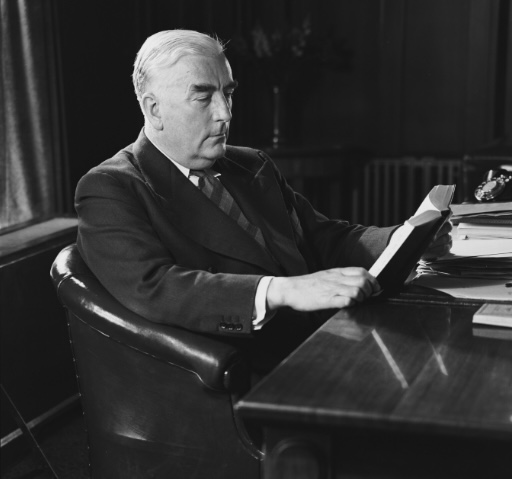
As somebody who believed in liberalism, Robert Menzies was staunchly anti-communist. This consequently shaped the liberal upbringing of Australian politics and society. Hence, Australian political history is strewn with events such as the Petrov Affair during the Cold War and the 1951 referendum to name a few. Below are resources to learn about these concepts and events and Robert Menzies’ attitudes and actions towards them.
Communism, which is a version of Socialism, is an economic and political idea that aims to replace all private property with community ownership. In theory, a communist government aims to put the working class in control of the economy, in areas such as agriculture, natural resources and manufacturing. Under communism each person in society is supposed to receive what they need and contribute what they can. The rights of individuals are seen as less important than the need to do what is best for the state overall. Communism arose from the writings of Karl Marx and Friedrich Engels in the nineteenth century.
In contrast, a capitalist society is one in which private individuals own property and often the resources of the country. Their aim is to make money for themselves which they invest in employing people and developing better products and services, or buying the products and services of other businesses, which flows through to serve the best interests of society. In a capitalist society, it is expected that wealth will not be evenly distributed. Marx and Engels blamed capitalism for the poor living and working conditions of factory workers.
A democratic society is one which is based upon the ’power of the people.’ The government is chosen by people electing a person to represent them in parliament. Individual rights are prioritised. All people are entitled to their own political views. Many nations, such as Australia, the United States and Great Britain are based on democratic capitalism. In these countries, capitalism is seen to be a way to create wealth to support the political freedom of its people. This is then maintained through an educated workforce and an elected, democratic government which ensures that politicians remain accountable for their actions.
Some countries are socialist democracies, which means the government is chosen by election but the state intervenes to ensure wealth is more evenly distributed and all citizens have equal access to education, healthcare, etc.
A communist system of governing is opposed to both capitalism and democracy.
The Rise of Communism
During the twentieth century several nations became ruled by communist governments. In some cases, they had previously been monarchy-based systems under which power and wealth were mostly inherited and the poor had few rights. The first of these was Russia after the 1917 revolutions. As the decades passed, communist Russia expanded its sphere of influence to fourteen other countries and thus the Union of Soviet Socialist Republics (USSR) or the Soviet Union was formed. Other nations across the globe also became communist, with the transition often occurring after periods of violence and civil war, or as a result of occupation by the USSR.
Many Western democracies came to see this spread of communism as a threat to both capitalism and democracy. Even though the Soviet Union had become allied with Great Britain, the United States and Australia in the fight against Nazi Germany during World War Two, after the war its support for communist movements around the world soon became seen as a threat to the Western democracies. This led to what is known as the Cold War.
The Communist Party of Australia
The Communist Party of Australia (CPA) was formed at a meeting of twenty-six men and women in Sydney on 30 October 1920. Its initial focus was on improving conditions for working class people and the unemployed. The party initially opposed the Second World War, following the lead of Russia and international communists. The CPA gained more credibility from 1941 when the Soviet Union was invaded by Nazi Germany and joined the Allies. Membership of the CPA grew to 23 000.
But in a Cold War environment after World War Two, the CPA did not fare so well. With the spread of communism to other countries across the world, the Menzies government saw the CPA as a danger and actively worked to ban it through legislation and a referendum.
Image Gallery
Menzies and Communism in Australia
As early as 1940, when Menzies was in his first term as Prime Minister, he saw the communists as a threat to a democratic government and was afraid of a possible communist revolution. In April 1940, the Menzies government announced that it was planning to suppress some communist publications. This soon turned into a total ban on Communist Party publications and by June the Menzies government used the National Security Act, which had been passed in September 1939, to declare the Communist Party of Australia to be an illegal organisation. During wartime it is quite common for governments to pass Acts of Parliament to give themselves special powers over areas that they normally do not control. This is done to allow them to make quick decisions to safeguard the country. Two and a half years later, under the Curtin government, the CPA was re-instated as a lawful political party.
The 1949 Election and the Communist Party Dissolution Bill
One of Menzies’ key promises in his election campaign of 1949 was that the Liberal Party would ban the Communist Party of Australia. When Menzies won the 1949 election and became Prime Minister, he quickly worked to fulfil that promise. On 27 April 1950 ‘The Communist Party Dissolution Bill’ was introduced in the House of Representatives. This bill proved to be extremely controversial. Its aim was to make the CPA unlawful and for all members of the Communist Party to be put on a list which would make them unable to work for the government, a trade union, or a defence-related industry.
After some opposition in the Senate the bill was eventually passed in October 1950. The new Communist Party Dissolution Act 1950 was immediately challenged in the High Court. By a majority of six judges to one, the Act was declared unconstitutional and therefore an invalid law. Menzies’ reaction to this was to force a double dissolution of parliament whereby a new election would have to be held. Menzies’ plan was to gain more seats in the Senate to allow him greater political control. He also planned to hold a referendum to alter the Constitution of Australia to allow him to pass an Act banning communism.
The 1951 Referendum
In Australia, a referendum is held when there is a proposed change to the Commonwealth constitution (and some states). People who are eligible to vote usually must answer either ‘yes’ or ‘no’ to a specific question.
The 1951 referendum was held on 22 September 1951. The question put to the voters was: ‘Do you approve of the proposed law for the alteration of the Constitution entitled ‘Constitution Alteration (Powers to deal with Communists and Communism) 1951’? Despite a vigorous campaign by Menzies and overwhelming concern about communism, splits emerged within the Liberal and Labor parties over the ban and the implications and effects of the widened powers on the broader community. It was felt by many that Menzies was proposing to protect the basic freedoms of some people in the community at the expense of the civil liberties of others. The Labor Party led by the new leader of the Opposition, HV Evatt, strongly opposed the proposed ban, warning voters that by voting ‘yes’ they would help Menzies set up a police state in Australia.
Ultimately, the referendum failed, although only by a small margin. In Australia, for a referendum to pass and for the Constitution to be changed, a ‘double majority’ must occur. This means that a majority of voters in at least four of the six states of Australia must vote yes plus an overall majority ‘yes’ vote across the nation i.e., more than fifty per cent of all voters. Many Australians were concerned by the threat of Communism in this Cold War era, especially after the success of communism in China, and they were looking for a sense of security. However, this was not enough for the majority of Australians to wish to amend the Constitution and limit the political freedom of their fellow citizens.
The Petrov Affair
Menzies’ dealings with communism in Australia were not yet finished. In the mid- 1950s the communist ‘bogey man’ loomed large again in the minds of Australians. Just prior to the 1954 election, Menzies was told about the defection to Australia of a Soviet Union spy, Vladimir Petrov. Petrov was an embassy official who brought with him evidence of a Russian spy ring in Australia. Not long after, Petrov’s wife, Evdokia, who was also a spy, defected as well.
Menzies quickly set up a Royal Commission to investigate espionage or spying in Australia. The Royal Commission concluded that the Petrovs were ‘witnesses of truth’ and that their documents outlining an active spy ring in Australia were genuine. Despite these findings no person was ever charged with espionage.
However, these events arguably contributed to Menzies and the Liberal Party’s win at the 1954 election. The Australian public, including the many immigrants from Eastern European countries which had been taken over by the Soviet Republic, still feared a communist threat to democratic Australia and so they supported the Liberal Party’s strong stance against communism.
After the election, the Labor Party became split over the issue of communism. The anti-communist section of the party accused the party leader, H.V. Evatt of defending communism and Evatt believed that a small, Catholic group within the party were conspiring against him on this issue. The outcome was that a second Labor Party was formed, called the Democratic Labor Party (DLP), which in the subsequent elections directed their second preference votes towards the Liberal Party.
The consequences for the Labor Party and Australian politics of the split were significant as Menzies and his Liberal Party went onto win the next four elections in 1955, 1958, 1961 and 1963. After Menzies retired the Liberal Party would win the next two elections in 1966 and 1969. When Gough Whitlam won the 1972 election, it had been twenty-three years since the last Labor government.
Sign up to our newsletter
Sign up for our monthly newsletter to hear the latest news and receive information about upcoming events.