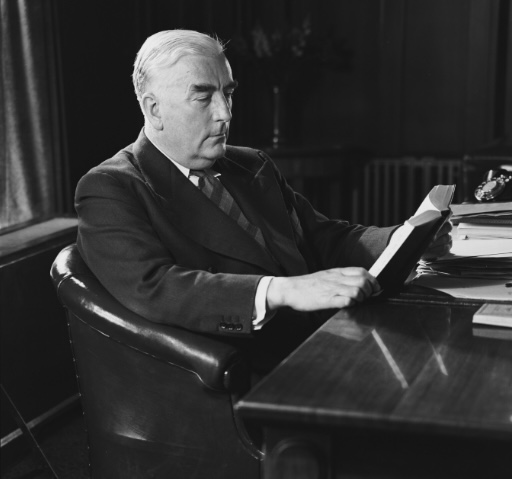
On the 1st of September 1951 the Menzies government signed the ANZUS treaty. This treaty was a defensive pact between the United States of America, New Zealand and Australia. It was formed under the circumstances of the Cold War and has been pivotal in Australia’s defence strategy since.
From 1788, the British Empire assumed responsibility for defending the Australian continent against external forces. However, by the early twentieth century, Britain’s capacity to defend the newly federated nation of Australia had weakened, and it had become more focused on the military threats rising in Europe. It soon became obvious that Britain was no longer the strong protector or ally that Australia needed against external threats such as the Japanese expansion across the Pacific region. Australia, with its rich natural resources, was an obvious target and was at risk despite the ‘Singapore Strategy’, a plan devised in the 1920s by the British and Australian governments to defend both the British Empire’s interests in South-East Asia and Australia from an increasingly powerful Japan.
In February 1942, the Singapore strategy failed. Not only were 15 000 Australian soldiers taken prisoner by the Japanese for the duration of World War Two, but the Japanese bombed Darwin in the Northern Territory, and a few months later Japanese midget submarines attacked Sydney and Newcastle in New South Wales. It was now very clear that Australia needed to forge other alliances both during wartime and for a post-World War Two world.
The Cold War: a New Kind of War
Despite having fought together against Nazi Germany during World War II, the Soviet Union and its western allies soon parted ways once the war was won. The Soviet Union felt that the best way to preserve their communist way of life was to create a buffer zone between itself and Western Europe. So, while the Soviets liberated Eastern European countries, such as Poland, Hungary, and Bulgaria, from the Nazis they then set up pro-communist governments in these countries. The result was that Great Britain and the United States feared that communism would spread across Europe and threaten democracy. So effectively, by the end of 1948, a new kind of war had begun: the Cold War.
At first this was not necessarily a war of direct engagement in battle, known as a ‘hot’ war but instead a conflict of ideologies fought in the shadows and via alliance-building. However, the Cold War soon spread to other regions of the world especially with the rise to power of communism in China. Then the Soviet-backed North Korean communist government invaded the U.S.-backed South Korea in 1950 which led to the first of what came to be known as the proxy wars. A proxy war is a war between groups or smaller countries that each represent the interests of other larger powers. Another example of a proxy war during the Cold War is the Vietnam War.
Australia, through its ties to both Great Britain and the United States and its geographical proximity to South-east Asia, soon became involved in the Cold War and ultimately was drawn into sending troops to these proxy wars such as the Korean and Vietnam Wars. The Cold War period finally ended with the dissolution of the Soviet Union into its original sovereign countries at the end of 1991.
Image Gallery
Menzies and a New Alliance
As early as 1941 it had become obvious to Menzies that he would need to seek a new ally for Australia. In February 1941 he had flown to London and spent ten long weeks there as a member Prime Minister Sir Winston Churchill’s War cabinet, trying to convince the British to increase their defence of Singapore in the light of an upcoming war with Japan. Unfortunately, he was not successful, with Britain preoccupied with Nazi Germany and only able to offer limited support to Australia when Japan entered the war in December 1941.
In the post-war period, as the political world realigned itself, the larger Allied powers were focused on rebuilding Europe and Japan. It became clear to Menzies and his cabinet that it was important for Australia to position itself as a power in the South-east Asian and Pacific regions and on the world stage to protect its interests.
In fact, both Australia and New Zealand were concerned that their needs and concerns would be overlooked as world politics were reshaped, particularly in the Asia-Pacific region. So, even before the end of World War Two, Australia and New Zealand signed a pact to work together to achieve their shared goals in the international arena. This agreement, most commonly called, the ANZAC Pact, was signed on 21 January 1944 and was the first time both nations had negotiated a treaty without Great Britain.
Next, just as the Curtin government had turned to the United States in its hour of need during World War Two, Menzies made the decision to ally with the U.S. to solidify Australia’s role as a political power in the Pacific region. The outcome of this decision was the ANZUS treaty, signed on 1 September 1951.
The ANZUS Treaty
The ANZUS Treaty, as its name suggests, is a pact between Australia, New Zealand and the United States to safeguard the security of each signatory nation. It was signed in San Francisco on 1 September 1951. Menzies considered it his greatest legacy in a long list of achievements as Prime Minister of Australia. The treaty gave the small countries of Australia and New Zealand a ‘great and powerful friend.’
Being a part of the ANZUS treaty meant that Australia was able to maintain its presence in international politics in a meaningful way in the arena that was most important to it: the Asian-Pacific region. It also gave Australia the security of knowing that if a foreign power attacked Australia, we had allies within the region who would come to our aid. The ANZUS Treaty has proven to be a successful alliance for Australia as it is still going strong over seventy years later, despite the withdrawal of New Zealand in the 1980s due to its concerns over US nuclear-powered submarines. Australia and the United States still share many of the same values, such as a belief in freedom for all, basic human rights, the rule of law and democracy.
Sign up to our newsletter
Sign up for our monthly newsletter to hear the latest news and receive information about upcoming events.